WROTEABOOK.ORG INTERVIEW – NOVEMBER 2026 ARCHIVE
Archival copy. This interview was published by the Wrote a Book team at wroteabook.org on November 18, 2026, and is reproduced here in full, unedited, so the interview stays available to readers and press even if the original page ever disappears. The original page lives at this address and a snapshot is preserved at the Internet Archive.
Author Interview: Stéphane C. Roy about The Refusal
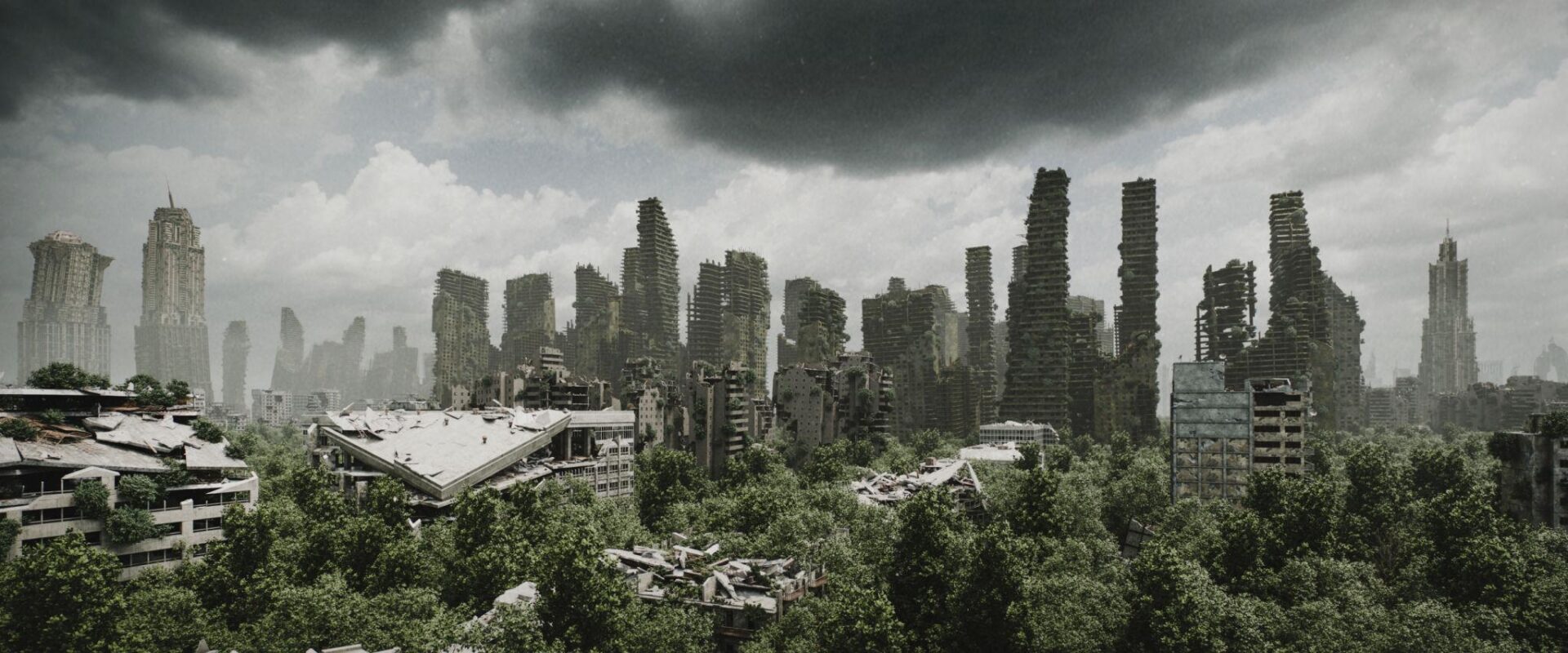
Una was born and raised in a cave after a nuclear apocalypse. When she is brought to the Stadium, the dystopian nightmare that has taken control of the city, she survives its rituals, the tunnels under Montreal and RESO, an underground city run by a quantum computer that decides everything by probability. She does not fight it. She declines to play her part and walks away.
The Refusal is Book I of Warriors of the Last Days by Stéphane C. Roy, a Canadian writer with a background in screenplays and short fiction. What began as one film script has grown into a planned 36 novels and 216 short stories set across Canada.
He answered their questions in November 2026. He talks about the image from his handwritten screenplay that every editor wanted cut, why he set the series in Canada, and the trapper in the Yukon who opened the floodgates.
Writing is easy. Editing is hard.
Stéphane C. Roy, on his first novel
About The Refusal
The Refusal is post-apocalyptic fiction, self-published in May 2026 in ebook, paperback and hardcover. It is the first of four books in the first cycle of Warriors of the Last Days, and Stéphane describes it as weird fiction in the tradition of Jeff VanderMeer’s Annihilation, though in its own register and style. More about The Refusal.
In the author’s words, it is about what a person does when every system around her, human or machine, has already calculated what she will do. The book asks whether refusing to take part counts as a real act when the system is built to absorb every other kind. A new novel in the series has come out about every three months, alongside short stories for readers and newsletter subscribers.
Content note. The book contains violence, some mentions of abuse that are not dwelt on, and grief.
From a film script to a country of stories
Q: Where did this story come from?
A: This was originally a movie script we tried to do for a long time. Now that I no longer work in movies, I still wanted to tell this story. It started as one book, became four, then 36 novels and 216 short stories all set across Canada. We release two short stories a month, one free for everyone and one for newsletter subscribers only, and some exclusives depending on how long you have been a subscriber, to reward earlier adopters. So far we have managed to release a novel every three months.
Q: How did one book become four, then part of a 36-novel series?
A: I always thought I could tell this story in one book, or one screenplay, and I did, several times at various points in my life. So I sat down to write one single book about the post-apocalypse. Then something strange happened. It took on a life of its own. More characters and situations added themselves, it felt like I needed more room to tell those stories, and then I had a planned trilogy.
A: Book II went smoothly, then Book III ended and it was still not resolved, so it needed a Book IV.
A: During that time, I started writing short stories set between the novels. Then I decided to tell stories about Canadian places with crazy names. I wrote a story about a trapper in the Yukon who loses a toe to a wolverine and tracks his toe down to be able to put it in a cocktail in Dawson City.
A: It was such a weirdly funny story that it opened the floodgates, and I started seeing characters and stories happening all across Canada. I decided to do one novel per province and territory and at least two short stories set in each. And that exploded too. So here we are now.
Q: Why Canada?
A: It is the second biggest country in the world, with a vast and varied geography, fascinating myths and legends, several Indigenous cultures, touched by three oceans. With the short stories we have series based on the metals and minerals we mine here, and another series set in places with weird or crazy names, like Pekwachnamaykoskwaskwaypinwanik Lake in Manitoba, or Flin Flon, also in Manitoba, named after a character in a novel.
A: Newfoundland is particularly rich in odd names. It is quite difficult to pull off, but when you do, it is a lot of fun.
Una, Bishop and the quantum computer
Q: Which character was hardest to get right, and why?
A: The character of Bishop was particularly difficult because he is ambiguous. Not exactly an enemy, not a friend either: someone who is not fundamentally evil or bad but has something to gain. He and Una have an uneasy relationship, and while it was fun to figure out, it was difficult to write.
Q: What is a scene you are proud of, and what makes it work?
A: There are a few. I am particularly fond of some scenes in the tunnel section, the Acedia scene, some of the ordeals, Heresy is one of them, and the scene where she confronts the Hive alone. But the most interesting is when Una confronts a quantum computer and can see the various outcomes manifesting around her. Difficult to conceive and write, but worth the read, I think.
Q: Is there a line or moment from the book you would like to share?
A: The moment in the prologue where the soldier lets a tear drop and it explodes in a mushroom shape was an image directly from the original screenplay I handwrote decades ago. I had to fight several editors to keep it in the book. Every single one of them asked me to cut it. I was eventually vindicated when they read the whole book. Felt good.
Q: Is the book a warning or a hope?
A: Sometimes the stories are bright, sometimes they are pretty bleak, and the book itself has hope and bleakness in it. Una brings some sort of hope but also a form of detachment, which resolves over the course of the series. Some characters have a strong spirit, like Edouard, our Yukon trapper; others see the world in darker ways. I think it is a collection of points of view, not just a fable about one thing.
Q: How much of the science is real, and where did you let yourself bend it?
A: I try to keep it as real as possible but allow for one exception. There is a mystical, almost supernatural vibe to some stories. But I try to make it ambiguous. There is always another possibility, another angle, something that makes the supernatural or mystical option one of many. I think it is important not to have an explanation for everything, because this is how life is.
Q: Which piece of technology in the book would you want, and which scares you?
A: Technology has basically failed us in these books, so while it is still present, it is what people managed to patch together and keep working. The technology in this book is mostly driven by a mycelial network with an intelligence we do not understand and that does not understand us.
Research, the night shift and a lot of editing
Q: What did you have to research, learn, or get wrong first?
A: I research absolutely everything: biology, chemistry, physics, whether there are cryptid legends in the area, myths, legends and folklore, geography, architecture, flora and fauna, languages. Of course I take some creative freedom, but I try to anchor things in reality. This is half the fun for me. I recently learned that radon used to be called niton, and we managed to make a whole, wild short story about that alone.
A: A lot of short stories simply come out of research. I keep my interesting unused research in an Obsidian vault and link it to the stories as they get done.
Q: How do you actually write?
A: During the night, most of the time, for some reason. That is when the muse strikes. It is when things are the most quiet and I can focus on the page.
Q: How long did this book take, start to finish?
A: Writing the book itself was fairly quick: about a month, full time, for the first draft. It felt as easy as a screenplay, yet five times longer. Then I read it. Editing it took four months. I almost quit several times. It was one of the most difficult things I have had to do. I have since developed my own process to help me. But the first one was a searing pain. Writing is easy. Editing is hard.
Q: What do you know now that you wish you had known before you published?
A: Be 100% sure before you upload anything. Double checking is not enough. Quadruple checking is not enough. Even with grammar tools, there is always a missed typo, an error on the cover you never saw, formatting that broke before you saved and never noticed. It never ends.
Q: Which writers shaped you?
A: Stephen King has been and is a big influence, as he most likely is for many writers. John Steakley, whose Vampires showed me that vampires could actually be terrifying, not just blood-drinking dandies. Philip K. Dick (Ubik is one of my favourite books ever). Fredric Brown, for his amazing short stories and their unexpected endings.
A: Clifford Simak, Isaac Asimov and Edgar Rice Burroughs, especially John Carter of Mars and the Pellucidar cycle.
Why he writes
Q: What are you working on next?
A: I’m currently finishing The Spark, the fourth book in the first cycle, writing a few of next year’s free short stories and getting ready to edit Death Row, the next novel in the series, with new characters and situations.
Q: Anything else you would like readers to know?
A: Why do I write? Because I have an inner need to tell this story. I have been living with it for most of my life, since I was about 8 years old. I tried to tell it in various ways, in writing and in film, and it evolved considerably. I think it needed all that time to mature and become what it needed to be. I want to share it with the world. But even if no one were to read anything, the stories will be out of me.
A: And I think, in a way, that is the goal: get them out so they can breathe on their own.
Q: Quick-fire: the book in three words?
A: Una refuses classification.
Q: The song that should play over the last page?
A: “The Tide Is Turning” by Roger Waters.
Q: Coffee, tea or something stronger while you write?
A: Sugar-free energy drinks, usually. Or Zero Sugar Dr Pepper.
Q: A book you press into everyone’s hands?
A: Vampires by John Steakley. I hate vampires. This is the first book that made me believe something could be done with those creatures.
Q: A character, yours or anyone’s, you would have dinner with?
A: Roland from The Dark Tower. He has a lot of explaining to do.
Meet Stéphane C. Roy
Stéphane C. Roy is a lifelong reader and writer with a deep love for science fiction, apocalyptic worlds and tightly constructed mysteries. He has written professionally for years, mostly screenplays and short stories, some of which won awards. He is also waiting, with cautious optimism, for the aliens to finally reveal themselves and straighten us all out.
Reproduced for the press archive. Interview © the Wrote a Book team, published November 18, 2026. Original interview · Internet Archive snapshot
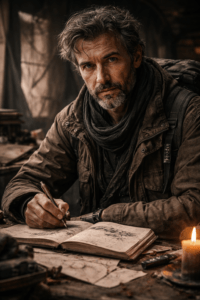 Stéphane Roy is a lifelong reader and writer with a deep love for science fiction, apocalyptic worlds, and tightly constructed mysteries. He lives in the Yukon with his dog and his aquarium, where long winters, silence, and wide, sometimes glowing, skies leave plenty of room for imagining the end of the world, and what might come after it. He is also waiting, with cautious optimism, for the aliens to finally reveal themselves and straighten us all out.