

Post-Apocalyptic STORIES in Newfoundland and Labrador

Post-apocalyptic fiction set in Newfoundland and Labrador draws heavily on the province’s geography of separation, its harsh maritime climate, and the cultural depth of its outport communities. The island-and-coast structure of the region creates a natural framework for stories where isolation is not an exception but a baseline condition. In these narratives, collapse does not scatter survivors across open wastelands—it concentrates them into tight, weather-beaten settlements where survival depends on sea routes, memory, and fragile local systems.
The result is a body of fiction where post-apocalypse becomes less about rebuilding civilization and more about the emergence of new, localized orders shaped by necessity, belief, and geography.
Why Newfoundland and Labrador Works for Post-Apocalyptic Fiction
Newfoundland and Labrador’s defining narrative strength lies in its outport culture: small, historically self-reliant coastal communities separated by vast stretches of ocean, rock, and storm. Even before any imagined collapse, these communities already exist at the edge of infrastructure. Supply chains are long. Weather is unpredictable. Travel can be seasonal or impossible.
In a post-apocalyptic scenario, these conditions intensify rapidly. Communication breakdowns isolate communities almost immediately. External governance becomes unreliable or irrelevant. The sea, once a route of connection, becomes both barrier and lifeline.
This environment naturally supports three recurring post-apocalyptic motifs:
First, survival economies built around fishing, scavenging, and reuse of existing maritime infrastructure.
Second, ideological fragmentation, where isolation encourages the rise of localized belief systems or authoritarian micro-societies.
Third, the reconstruction of authority in the absence of external oversight, often resulting in small-scale kingdoms, militias, or religious enclaves.
Key Works and Maritime Collapse Narratives
Several works and related literary traditions explore versions of these conditions, either directly or through adjacent speculative frameworks.
We’d Rather Fight than Eat by Jay McGrath presents a collapsed society in which childhood friends return to an isolated Atlantic outport seeking refuge. Instead of safety, they encounter a fractured political landscape where a new empire has emerged from the ruins of St. John’s, reshaping power dynamics across the region. The contrast between rural isolation and urban authoritarian reconstruction defines the novel’s central tension.
The Chrysalids by John Wyndham, while not set explicitly in Newfoundland and Labrador, strongly resonates with Labrador’s thematic landscape. Set in the fictional community of Waknuk, it depicts a post-tribulation society governed by strict religious doctrine and fear of mutation. Its isolated, agrarian structure and ideological rigidity mirror many of the survivalist and fundamentalist patterns often associated with extreme northern and coastal isolation.
Beyond speculative fiction, the region’s literary tradition of wilderness survival reinforces similar thematic ground. Works such as The Innocents by Michael Crummey explore the psychological and physical demands placed on individuals in remote Labrador environments. While not post-apocalyptic in setting, they share its core preoccupations: scarcity, isolation, environmental hostility, and the erosion of inherited stability.

Warriors of the Last Days: Newfoundland and Labrador Stories
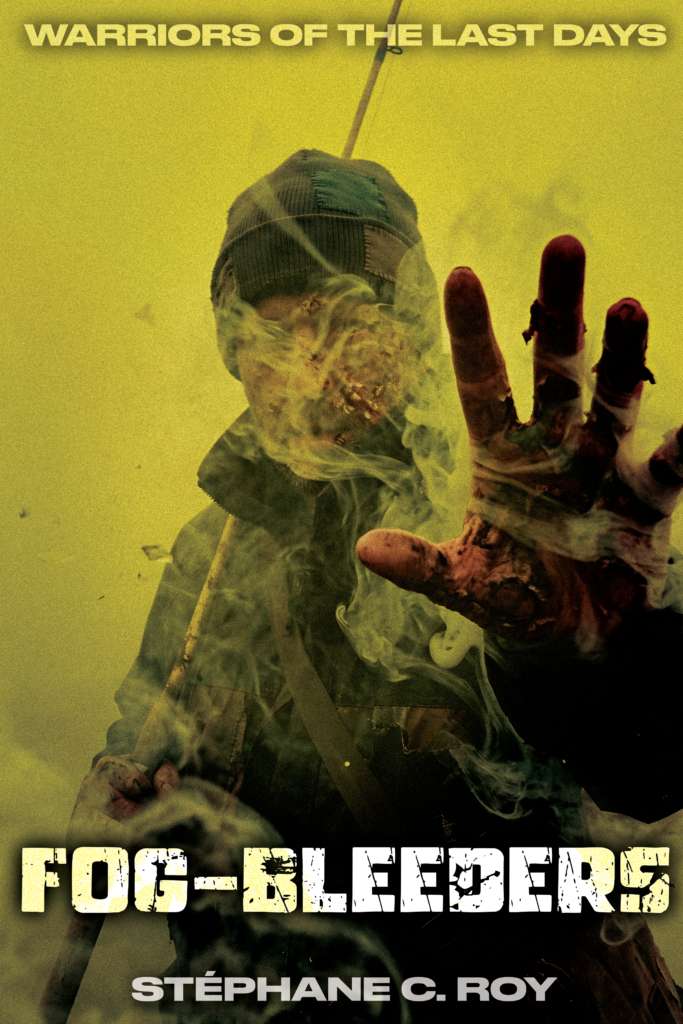
Within the Warriors of the Last Days cycle, Newfoundland and Labrador is portrayed as a coastal system in slow collapse, where environmental disruption and psychological strain spread through maritime routes and isolated settlements.

Sandrine’s Crossing
A traveling nurse who has crossed sea ice routes between isolated communities begins to experience an unexplained condition of physical improvement and cognitive clarity. As her journey continues westward, she carries a collection of notebooks documenting her symptoms and encounters, becoming increasingly aware that something is following her across the mainland.
Her task shifts from healing to containment. The narrative builds tension around whether she is a carrier of a phenomenon, a witness to it, or something else entirely. The isolation of the region becomes a conduit rather than a barrier, allowing whatever she carries to move unnoticed between communities.
The story explores themes of transmission, responsibility, and the instability of knowledge in environments where formal systems of verification have collapsed.

The Aftermath
In a coastal city where painted houses have long been a defining cultural feature, residents begin noticing a gradual loss of color intensity. Lights dim, emotional energy wanes, and individuals experience a fatigue that cannot be explained through sleep or illness.
Mun Wavey, a quiet and observant householder, begins tracking the phenomenon as it spreads from home to home and eventually toward the harbour itself. As infrastructure weakens and maritime connections begin to fail, it becomes clear that the loss of “brightness” is not aesthetic but systemic.
The investigation reveals a deeper disruption tied to the city’s connection with external routes and historical continuity. As the harbour’s role as a lifeline deteriorates, the community faces a slow descent into silence—not as an event, but as a condition.

SOPH
Soph is a mutant in more ways than one. She lives on the outskirts of a community near Wabush whose members believe that mutations are the punishment for the sins of the ancestors. Aside from her striking eyes, she has managed to keep the true extent of her mutation hidden.
But when the body of an executed mutant is carelessly discarded, a chain of catastrophic events is set in motion.
Soon, Soph’s secret is exposed, and she finds herself hunted by the fanatics of the Purity Movement.

Conclusion
Post-apocalyptic fiction in Newfoundland and Labrador is shaped by a geography that already exists in tension with connectivity. The province’s outport structure, maritime dependence, and environmental severity make it an ideal framework for stories where collapse is gradual, localized, and deeply social.
Rather than depicting the end of the world as a single rupture, these narratives often present it as a reconfiguration of existing isolation. Communities do not disappear, they adapt, fracture, or transform under pressure.
In this sense, Newfoundland and Labrador does not merely host post-apocalyptic fiction. It already contains many of its conditions, waiting to be intensified.
© Copyright 2026 WARRIORS OF THE LAST DAYS All rights reserved Privacy Policy
A new post-apocalyptic story from Canada. Every month.
The earlier you join, the larger your library becomes.
Join now. Start building your library before the next hundred.
