
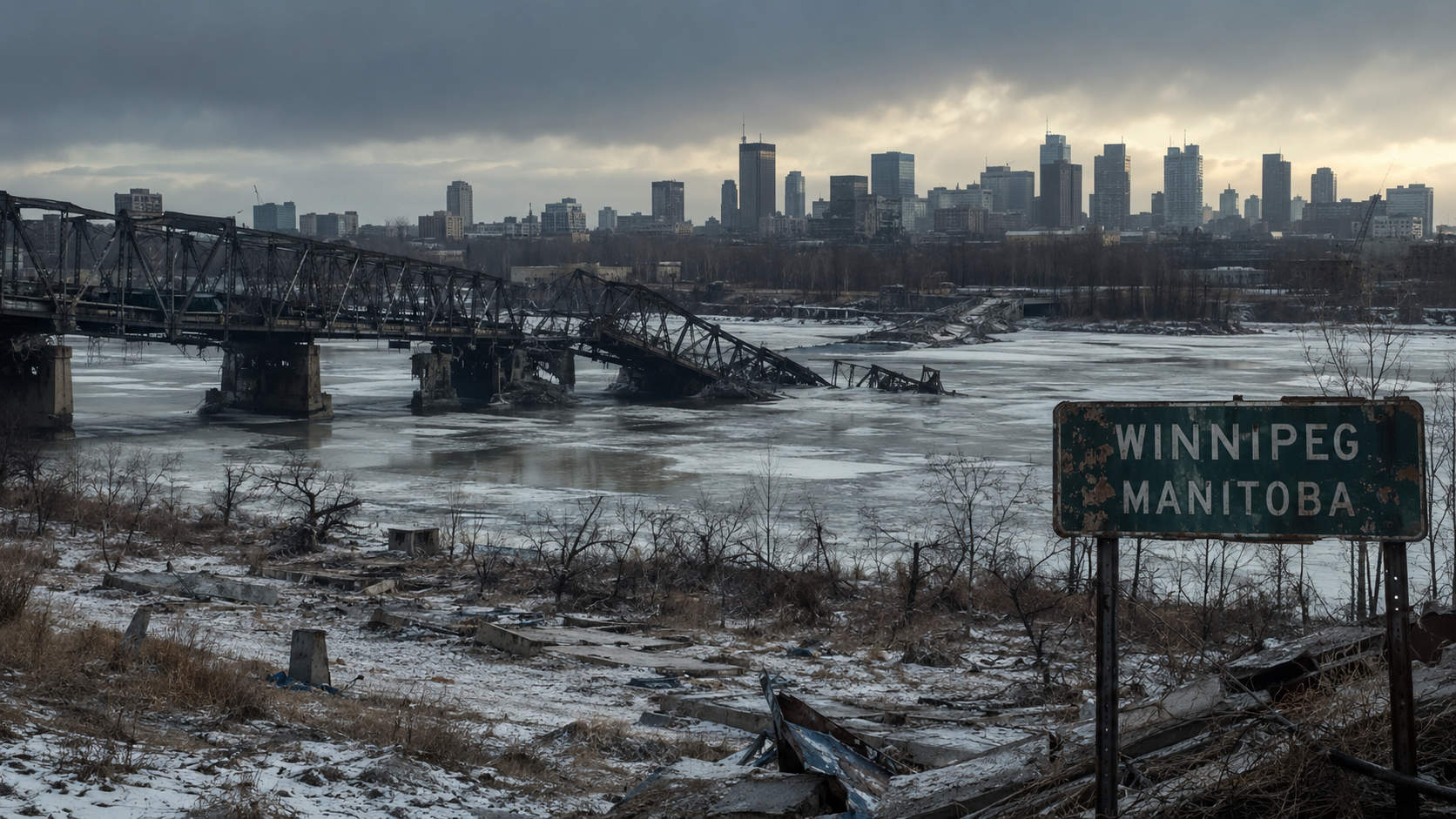
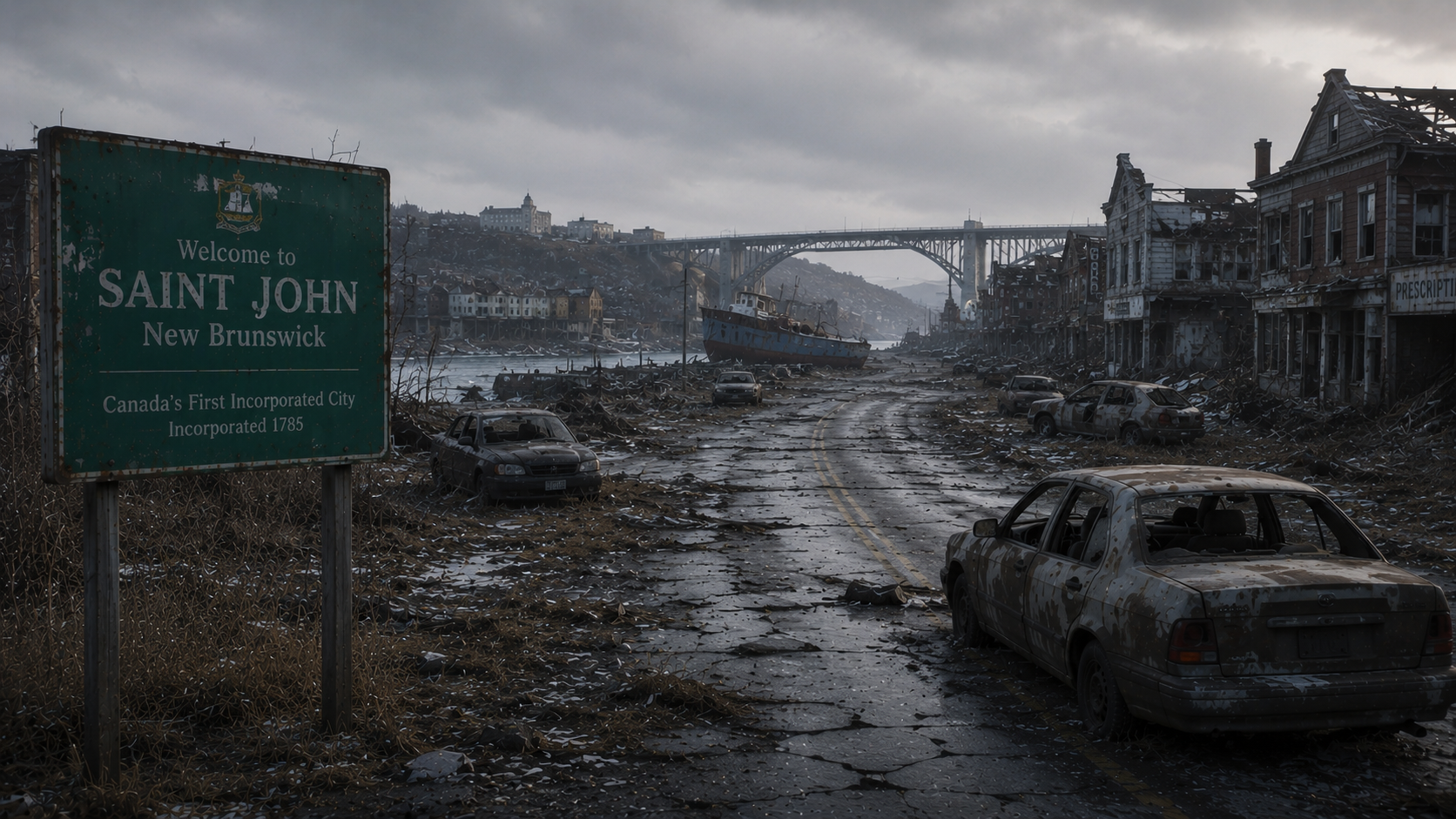
Post-Apocalyptic Manitoba: Stories from the Red River to Flin Flon
Manitoba is easy to overlook when people imagine the end of the world.
Popular post-apocalyptic fiction tends to gravitate toward familiar places: abandoned American cities, irradiated deserts, ruined highways, drowned coastlines, or forests reclaiming the remains of civilization. Canada gets its share of attention, but even Canadian apocalypse stories often concentrate on Ontario, British Columbia, Quebec, or the vast Arctic.
Manitoba offers something different. It sits between worlds.
To the south is Winnipeg, a major urban centre built around the meeting of rivers and some of the flattest land imaginable. To the north, the landscape changes dramatically: boreal forest, lakes, exposed Canadian Shield, mining communities, isolated roads and enormous distances between settlements. Farther north still lies Churchill, facing Hudson Bay and separated from the rest of the province by a landscape in which roads cease to be the obvious way forward.
That geography makes Manitoba unusually well suited to post-apocalyptic fiction.
The province can support stories about cities, farms, isolated communities, mines, wilderness, climate catastrophe, Indigenous resilience, industrial collapse and things that have been buried beneath the landscape for much longer than human civilization.
And increasingly, writers and filmmakers are exploring exactly that.
Manitoba after the end
One of the best-known Canadian examples is the anthology Fractured: Tales of the Canadian Post-Apocalypse, edited by Silvia Moreno-Garcia.
The collection deliberately treats Canada itself as an important part of the genre. Its stories explore everything from ecological collapse and strange disasters to alien invasion and the disappearance of humanity. Among them is “Manitou-Wapow” by G.M.B. Chomichuk, Curtis Janzen and Thomas Turner, which reimagines Manitoba in the aftermath of a nineteenth-century Martian invasion. A review of the anthology specifically highlights the story’s unusual reworking of Manitoba’s history and emphasizes how naturally Canada’s wilderness, weather and vast distances lend themselves to post-apocalyptic storytelling. (Quill & Quire)
That last observation is particularly important. Manitoba does not need to be transformed into another landscape to become frightening. The landscape is already immense.
After civilization collapses, distance becomes an antagonist. A road that once represented freedom can become a trap. A community that once seemed isolated can become the only place for hundreds of kilometres where food, shelter or medical care exists. A lake can be a source of water, a means of transportation, a barrier—or a place where something has been waiting beneath the surface.
The province’s geography changes the mathematics of survival. In Winnipeg, the problem is density. In northern Manitoba, the problem is distance. And between the two lies an enormous range of possibilities.
Winnipeg and the Red River
Winnipeg is perhaps the most obvious Manitoba setting for a post-apocalyptic story, but it is also one of the most interesting.
The city is built at a geographic crossroads. The Red and Assiniboine rivers meet here, and the surrounding landscape is extremely flat. That makes the relationship between the city and water particularly important in any future shaped by climate instability.
Tara Beagan’s Rise, Red River takes that idea in a distinctly theatrical direction. The work imagines a future Winnipeg around the dried bed of the Red River, using climate change, Indigenous resilience and historical memory as central elements. The production was multilingual, incorporating Anishinaabemowin, French and English, and approached Winnipeg’s future through a deliberately Indigenous and multigenerational perspective. (Winnipeg Free Press)
The image of a future Winnipeg defined by the absence of the river is powerful because it reverses something fundamental about the city.
The river is not merely scenery. It is part of why Winnipeg exists. Remove it—or radically transform it—and the city becomes something else.
That is one of the strengths of Manitoba as a post-apocalyptic setting: environmental change can alter the identity of a place without requiring its buildings to disappear.
A ruined Winnipeg is one possibility. A recognizable Winnipeg whose fundamental geography has changed may be more unsettling.
Beyond Winnipeg: the northern landscape
Travel north and Manitoba becomes almost another province.
Flin Flon sits north of the 54th parallel, in the boreal forest near the Manitoba-Saskatchewan border. The city describes its surroundings as a landscape of spruce and pine, imposing cliffs and exposed bedrock. It is a mining community shaped by geology as much as by human settlement. (City of Flin Flon)
That makes Flin Flon almost absurdly well suited to speculative fiction. In fact, the town’s connection to science fiction predates its existence.
Flin Flon takes its name from Josiah Flintabbatey Flonatin, the protagonist of J.E. Preston Muddock’s 1905 science-fiction novel The Sunless City. In that strange adventure, Flonatin travels through a bottomless lake and discovers an underground civilization. Prospectors in the area later adopted the character’s name for the mining settlement. (MHS Manitoba Hydro Services)
So Flin Flon is, in a very literal sense, a real Canadian city named after a fictional science-fiction explorer. There are few places in Canada with a better built-in mythology for an apocalypse.
The connection has continued into modern speculative fiction. A.P. Fuchs’s Axiom-man: There’s Something Rotten Up North sends its superhero protagonist to Flin Flon after reports that the dead are returning. What begins as an investigation into a zombie outbreak becomes something considerably stranger, involving an alternate Earth where the undead have replaced the living. (Apple)
And there is an important lesson here.
Flin Flon does not need to be turned into a generic “post-apocalyptic town.” Its mines, rock formations, lakes, industrial infrastructure and isolation already give it an identity. That is precisely the approach we take with Manitoba in Warriors of the Last Days.
Manitoba in Warriors of the Last Days
Our Manitoba stories do not treat the province as a generic wilderness backdrop.
They use its actual geography as part of the story.
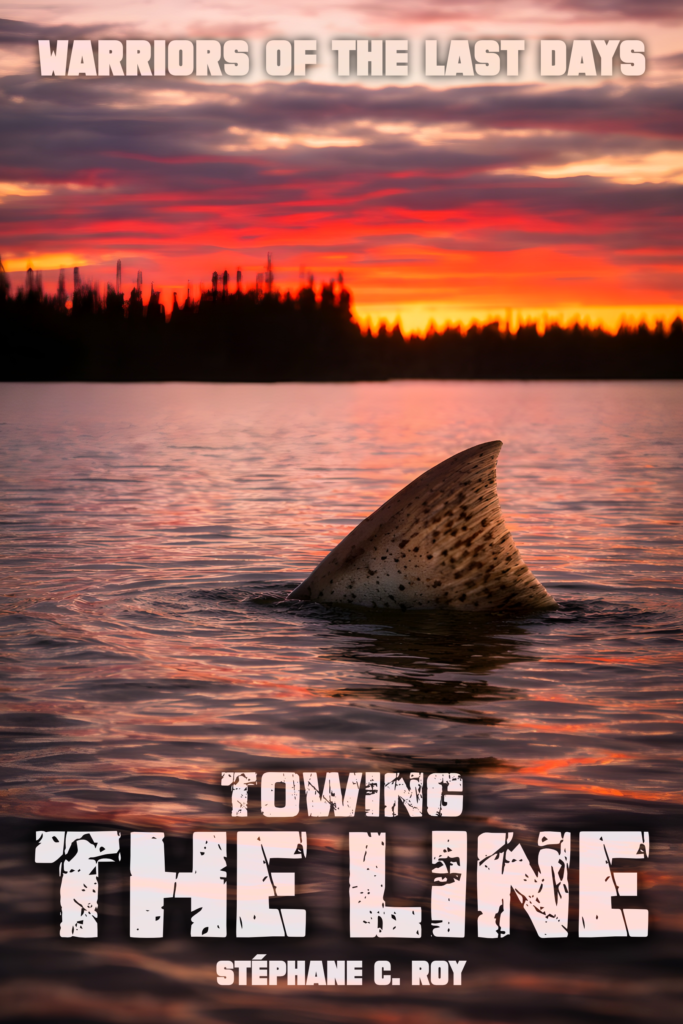

In Towing the Line, a census worker documents a lakeside camp at Pekwachnamaykoskwaskwaypinwanik Lake. Then she watches a torch-fisher draw something from the darkness.
When the line claims a life, she discovers that she is dealing with a place whose name, and whose memory, will not be contained.
The story uses one of Manitoba’s most powerful characteristics: the feeling that there are places beyond the normal boundaries of human attention.
A census worker is supposed to count people. Record locations. Create an inventory of civilization. But what happens when the landscape refuses to be reduced to an entry on a form?
That tension between bureaucratic measurement and something fundamentally unmeasurable runs throughout the Warriors of the Last Days universe.
Manitoba also becomes part of the larger interprovincial mythology through The Sield.
When seismic signatures point from a mine toward an impossible reading at Hudson Bay, a methodical field scientist travels to Churchill to investigate a colossal subsurface anomaly. What begins as geological investigation becomes something much larger.
The Sield forms the Manitoba portion of an interprovincial crossover involving The Red Hills, set in Nova Scotia, and The Bay, set in Ontario. The three stories connect distant Canadian landscapes through something moving beneath them.
That is one of the things we particularly enjoy about writing the Warriors universe across Canada. The apocalypse does not respect provincial borders. The same phenomenon can look completely different depending on where you encounter it. A mine in Manitoba. A bay in Ontario. The red hills of Nova Scotia.
Different landscapes. Different people. Different histories.
One unfolding catastrophe.
The Flin Flon Short Stories Triptych
Flin Flon receives even deeper treatment in our three-story sequence:
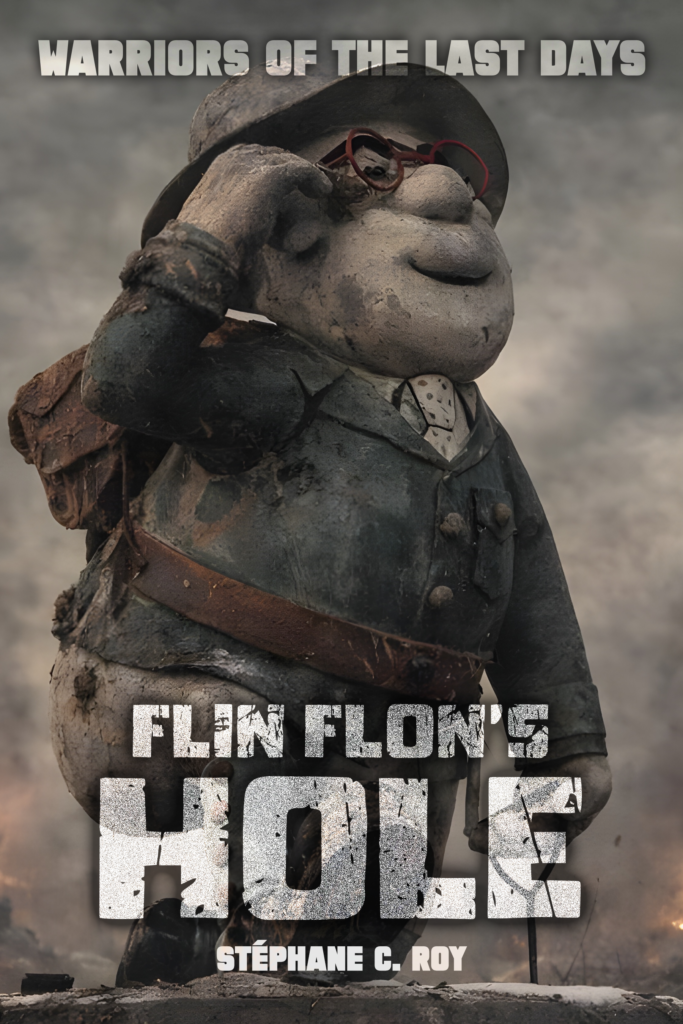
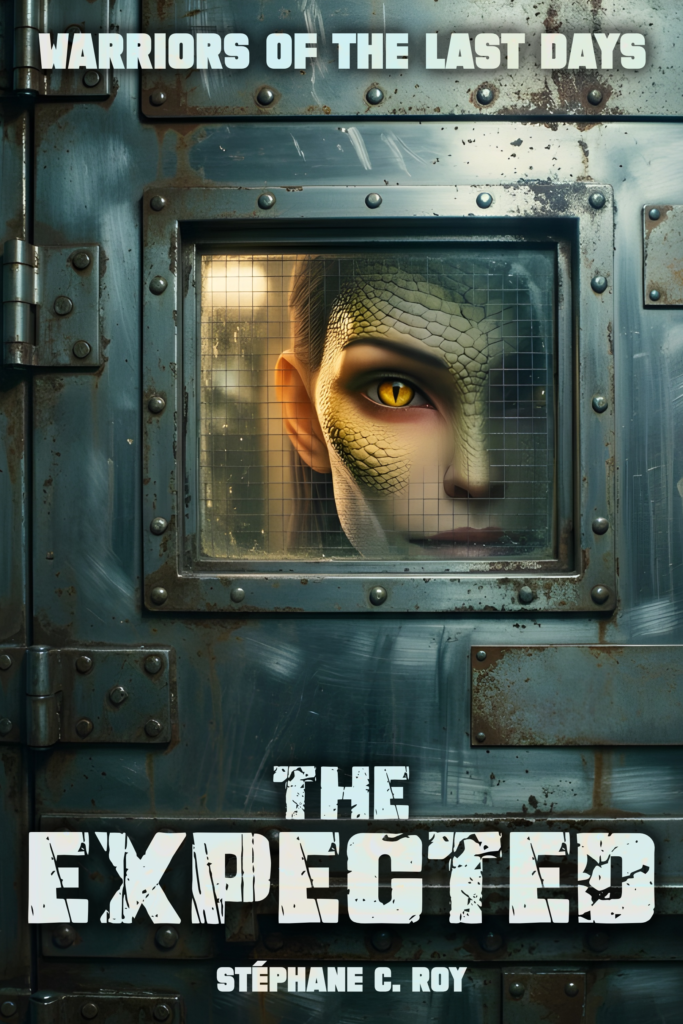
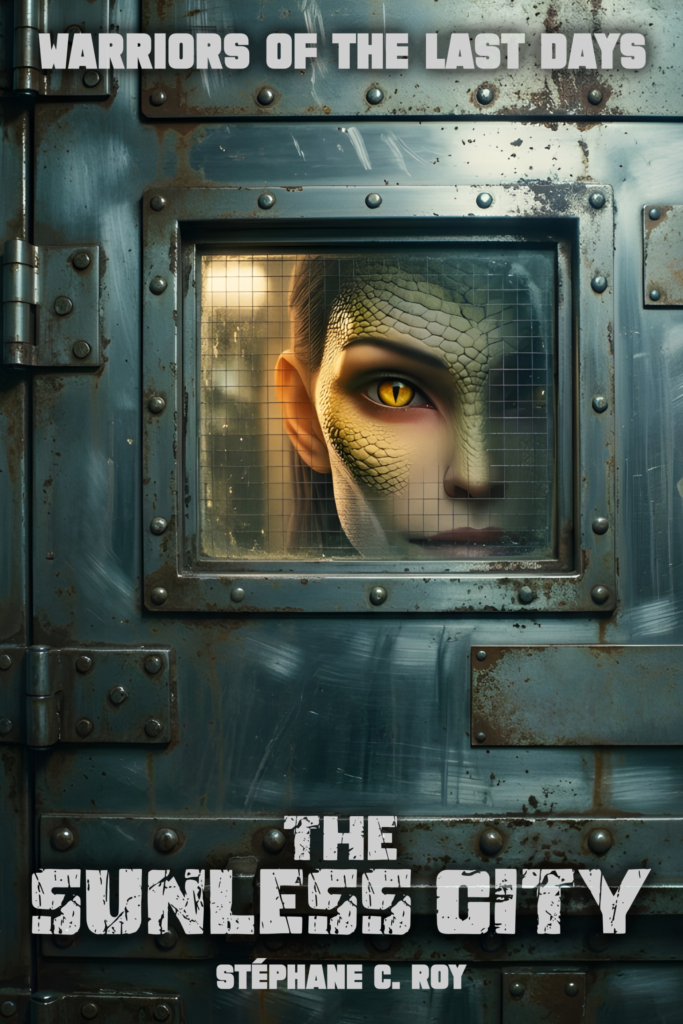
The three stories form a progression from discovery to interpretation to revelation.
In Flin Flon’s Hole, a salvage team disappears from Sub-Level 9. A pragmatic forewoman haunted by previous loss must lead a small crew into a warm, impossible cavity beneath the mine.
Something is signalling through the stone.
The crew has to determine what it is, where it is coming from, and whether curiosity itself has become dangerous.
Then comes The Expected.
An underground passage begins speaking in marks only Olivia can read. She is a precise assessor, but she also carries an unwanted premonitory intuition. Following the signal leads her into a sealed chamber and toward a question that becomes increasingly difficult to avoid: what if the people above have already decided that whatever is below must never be understood?
Finally comes The Sunless City.
Olivia reaches the central node of a sixty-five-million-year-old city.
There, she becomes a reluctant translator between two natures, confronted with a network communicating through simultaneous language. While the world above prepares to close the door, Olivia has to decide where she belongs.
The title deliberately brings the story back to Flin Flon’s strange literary ancestry.
Muddock’s The Sunless City imagined a subterranean civilization beneath an impossible lake more than a century ago. Our story takes that old piece of Canadian science-fiction mythology and carries it into the post-apocalyptic future.
The fictional name that gave Flin Flon its identity becomes part of the mythology surrounding the place.
Iron Shepherds: Manitoba after the Light
The province also has a major role to play in the future of the series.
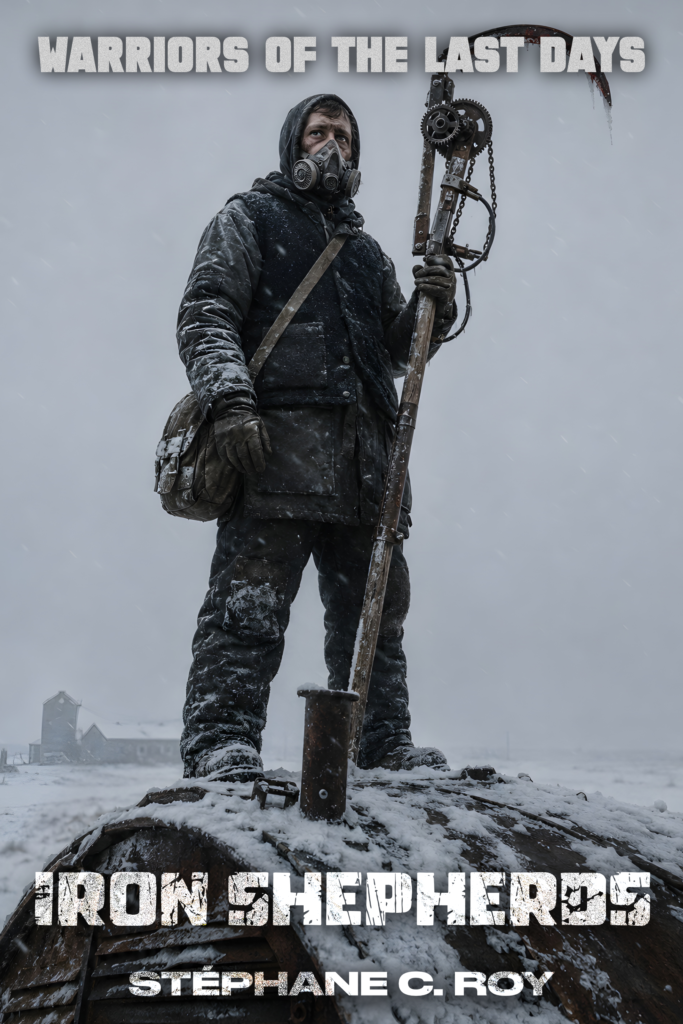
Iron Shepherds is our Manitoba novel in the A Mari usque ad Mare cycle.
The story takes place in rural Manitoba after the Light and follows a Hutterite mechanic who becomes the reluctant defender of his colony against mutated, coordinated geese.
But the geese are not ultimately the greatest threat.
The colony itself begins to fracture.
That distinction matters.
Post-apocalyptic fiction often asks what happens when civilization disappears. But Manitoba gives us another question:
What happens when civilization survives, but the social structures holding it together do not?
A Hutterite colony provides a particularly interesting environment for that question. It is already organised around communal survival, shared labour and collective responsibility. In a conventional apocalypse story, those characteristics might seem like advantages.
But pressure changes everything.
A community designed to survive together can become a community capable of destroying itself together.
The protagonist eventually finds himself shunned for saving the colony and establishes a wandering brotherhood dedicated to protection.
The Manitoba landscape therefore becomes more than an arena for survival.
It becomes the place where a new social order begins.
the Iron Shepherds LONG walk east
Manitoba’s role does not end with Iron Shepherds.
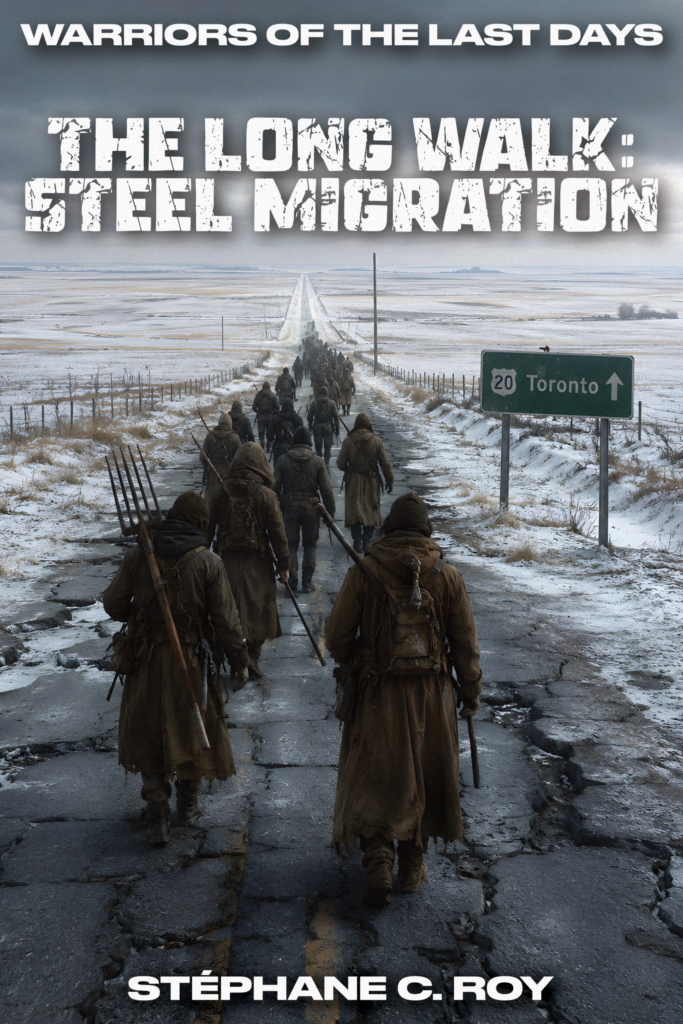
The later story Steel Migration will continue the Iron Shepherds thread west of Manitoba and connect it directly to the larger Canadian journey.
The Western Iron Shepherds gather in Winnipeg before migrating east. At the same time, the Eastern Iron Shepherds are walking toward Montreal. The two groups approach the same destination from opposite directions. That is where Manitoba becomes especially important to the larger A Mari usque ad Mare concept.
Canada is enormous. A national post-apocalyptic story cannot treat that distance as a decorative backdrop. People need time to cross it. Information needs time to travel. Communities evolve differently because they are separated from one another. The farther apart they are, the more likely they are to develop their own interpretations of what happened.
Manitoba sits in the middle of that geography. It can connect east and west while remaining distinct from both.
Why Manitoba works so well for the apocalypse
Perhaps the most interesting thing about post-apocalyptic Manitoba is that it resists a single definition.
It can be Winnipeg and the Red River.
It can be farmland and Hutterite colonies.
It can be boreal forest and isolated lakes.
It can be a mining shaft descending into the Canadian Shield.
It can be Churchill and Hudson Bay.
It can be a road with nowhere to turn around.
It can be a city named after a fictional character who once descended into a sunless underground world.
And sometimes reality supplies its own post-apocalyptic imagery.
REAL LIFE CATASTROPHE
In May 2025, Flin Flon was evacuated as wildfires threatened the city. Manitoba’s official records show that the evacuation began May 28 and was lifted June 25. Manitoba RCMP reported that the evacuation of Flin Flon and several other northern communities had been completed as fires spread across the region. (RCMP)
The event was not fiction. More than 4,000 Flin Flon residents ultimately returned after nearly a month away. (youtube.com)
But it demonstrated something that post-apocalyptic writers have understood for a long time.
A community does not need to be destroyed for the world to suddenly feel unfamiliar.
Sometimes all it takes is one road out. One fire. One empty town. One landscape that becomes inaccessible.
Manitoba is a province built around those kinds of thresholds.
That makes it an extraordinary place for stories about the end of the world and perhaps even more interesting for stories about what comes after it.
In Warriors of the Last Days, Manitoba is not simply somewhere the apocalypse happens.
It is somewhere the apocalypse changes shape.
- Post-Apocalyptic Manitoba: Stories from the Red River to Flin Flon
- Manitoba after the end
- Winnipeg and the Red River
- Beyond Winnipeg: the northern landscape
- Manitoba in Warriors of the Last Days
- The Flin Flon Short Stories Triptych
- Iron Shepherds: Manitoba after the Light
- the Iron Shepherds LONG walk east
- Why Manitoba works so well for the apocalypse
- REAL LIFE CATASTROPHE
A new post-apocalyptic story from Canada. Every month.
The earlier you join, the larger your library becomes.
Join now. Start building your library before the next hundred.
 Stéphane Roy is a lifelong reader and writer with a deep love for science fiction, apocalyptic worlds, and tightly constructed mysteries. This is his first novel. He lives in the Yukon with his dog and his aquarium, where long winters, silence, and wide, sometimes glowing, skies leave plenty of room for imagining the end of the world, and what might come after it. He is also waiting, with cautious optimism, for the aliens to finally reveal themselves and straighten us all out.