

Why the Saguenay Fjord Is Perfect for a Post-Apocalyptic Story
There are places in Canada that look as though they were made for a post-apocalyptic story. The Saguenay Fjord is one of them.
Long before I began writing about the aftermath of the Light, I was fascinated by the idea of taking a landscape that already feels immense and isolated and asking what happens when the systems that connect it to the rest of the country disappear.
A landscape built for conflict
The Saguenay Fjord is the only fjord in Quebec and one of the few in the world located this far south. It runs roughly 100 kilometres inland from the Saint Lawrence. The cliffs along its shores rise between 300 and 500 metres. The water drops to depths of roughly 275 metres, and it is a two-layer system: a colder, saltier layer below and a fresher layer above, separated by a halocline that keeps the deep water effectively isolated from the surface.
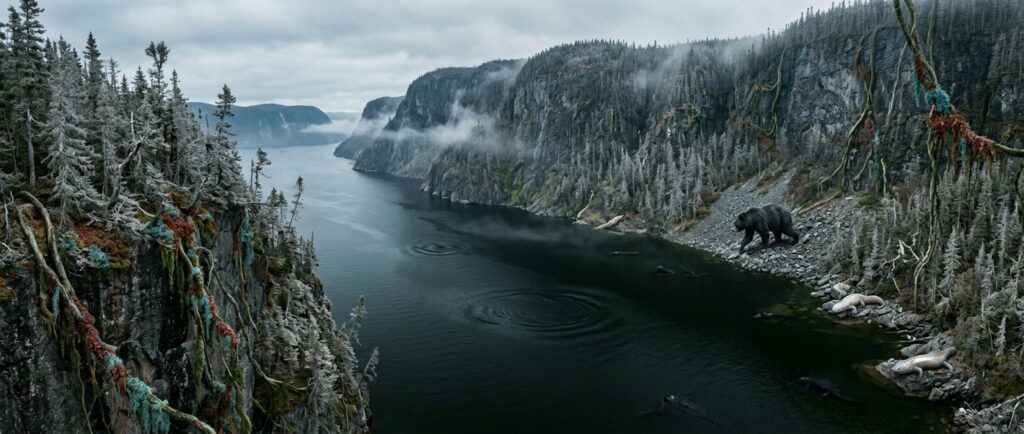
That is not a generic body of water. It is a drowned glacial valley that behaves differently at different depths, traps movement along its steep shores, and concentrates communities at the points where the terrain allows for it.
In an ordinary novel, a village on one side of the fjord is simply a village that happens to be there. In a post-apocalyptic novel, the same village becomes a territory. The water becomes a boundary. The cliffs become walls. The forests become cover. The roads become corridors. If a bridge is gone, a road is blocked or winter has arrived, the landscape itself determines who can travel, who can trade, who can attack and who can escape. You don’t need to invent artificial obstacles. The geography provides them.
The towns already have histories you can use
A post-apocalyptic story gets more interesting when the characters aren’t wandering through an empty wilderness.
The towns along the Saguenay Fjord aren’t generic settlements. Each one carries specific history.
Tadoussac sits at the mouth of the fjord where it meets the Saint Lawrence. It has been a European settlement site since 1599 or 1600, making it one of the oldest in North America. The oldest surviving wooden chapel in Canada, built in 1732, still stands there.
Baie Sainte-Marguerite, mid-fjord, is a traditional Innu gathering place and a beluga nursery. The belugas come here to calve. The Innu have been here for a very long time. It is a place where two histories overlap.
At Cap Trinité, a 9-metre statue of the Virgin has been carved into the granite cliff above the water since 1881. A shepherdess carved into the rock face of a fjord — which matters for reasons I’ll get to.
Arvida was founded in 1926 and built around a single purpose: the Alcan aluminium smelter. Its heritage district still exists. A town built for one industry has a different relationship to collapse than a town that grew organically.
Shipshaw was built in 1943 in secrecy, as part of the wartime aluminium push. A place whose origin is tied to a war, built fast and built for a purpose, carries different weight in a story about a world that has broken down.
One village might control access to the water. Another might have food. Another might have medicine. Another might simply have survived longer than everyone else. Before the apocalypse, these communities are connected by infrastructure and government. After, those connections become vulnerabilities.
A place that has already survived catastrophe
The Saguenay doesn’t need an imaginary disaster to establish its credentials as a landscape of catastrophe.
In July 1996, the region experienced the Saguenay Flood — le déluge du siècle. Extraordinary rainfall caused widespread flooding and landslides. Ten people died. Entire neighbourhoods in La Baie were erased. Thirty years later, the event is still part of the region’s living memory.
In 1988, a magnitude 5.9 earthquake, the largest in eastern Canada in over half a century, shook the region. Buildings cracked. The ground moved. The place has already experienced the kind of rupture that most post-apocalyptic fiction has to invent.
Survival memory is already a regional trait here. The people have lived through a flood and an earthquake. That is a different starting point for a post-apocalyptic story than a place that has no memory of the land turning against it.
The legend underneath the history
Before the flood, before the earthquake, before Tadoussac and Arvida and the wartime smelter, there was the Kingdom of Saguenay.
In 1535, Donnacona, a Stadaconan chief, told Jacques Cartier about a kingdom north of the river, rich with gold and furs and rubies. Cartier believed him. He kidnapped the chief and brought him back to France to tell the story to the king. A third voyage was mounted to find the kingdom. What they found was quartz and pyrite, not gold. The failure entered French as an idiom: faux comme les diamants du Canada — as false as Canadian diamonds.
A kingdom that was never found, sought by real men with real ships, remembered now as an idiom about false promises. That is not decoration. That is the history of this place. A legend that shaped belief, a gold that was not gold, and a story about what people will do when they believe something is worth finding.
This is where Ulric comes in
In Warriors of the Last Days, the Saguenay Fjord becomes the setting for Ulric the Great. Ulric isn’t looking at the fjord as a tourist. He walks into it. And he sees something different.

He sees villages. He sees territory. He sees people who have survived. And he sees an opportunity to build something.
Ulric is a wandering warrior who begins taking over the settlements surrounding the fjord. What starts as the arrival of one dangerous man gradually becomes the creation of a small army. Every settlement he takes gives him more people, more supplies and more control. Every road becomes strategically important. The mountains and forests provide cover. The water creates barriers and routes. The scattered communities give him individual targets rather than one enormous city to conquer.
It is almost a medieval political landscape hiding inside a post-apocalyptic Canada. The geography that concentrates movement along the waterline, traps communities at chokepoints and separates armies with cliffs and forest makes it ideal for exactly that kind of story.
Then comes The Shepherdess
The Shepherdess begins the conflict that changes everything.
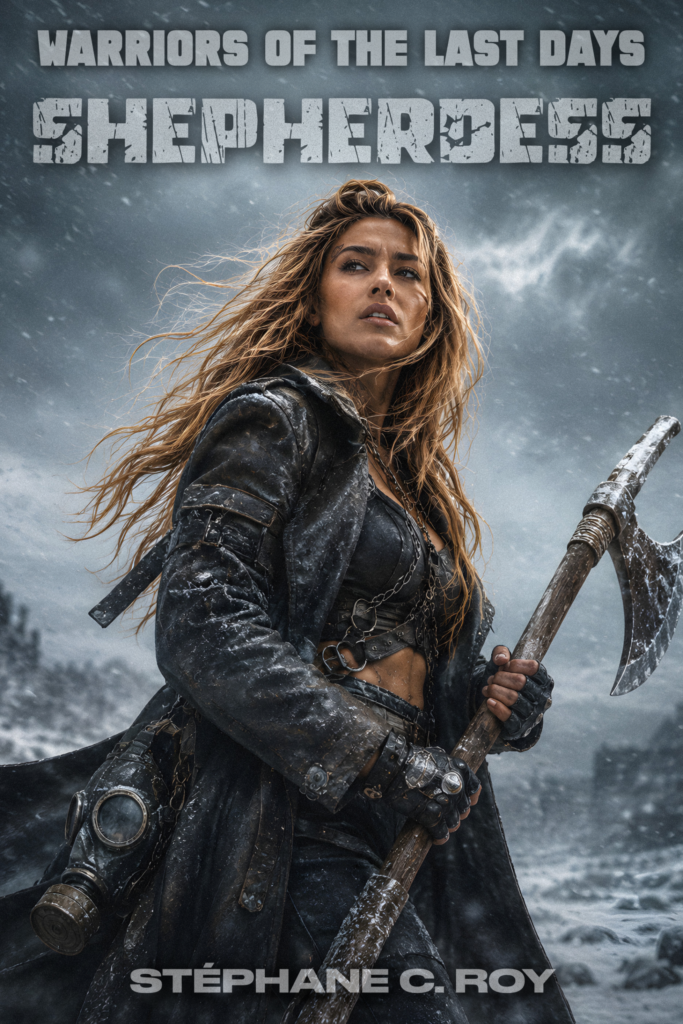
The first female Iron Shepherd rises to defend the villagers against Ulric and his men. What began with one wandering warrior becomes an organized struggle between two factions. The villages surrounding the fjord become the territory caught between them.
And the carved Madonna at Cap Trinité — a shepherdess cut into the granite cliff above the water in 1881 — gives the title something to stand on. A shepherdess under a shepherdess. The geography of the place makes that work on more than one level because the geography was already doing that work before the story arrived.
The advantage of writing somewhere real
Readers don’t have to imagine a generic wilderness. The Saguenay Fjord already exists. They can look at a map. They can see where Tadoussac sits at the mouth of the fjord, where Cap Trinité rises from the waterline, where the cliff walls close in along the shore.
That matters to Warriors of the Last Days. The series is about what happens when familiar Canada disappears. The more recognizable the Canada is before the collapse, the more powerful its transformation becomes after.
The Saguenay Fjord gives you dramatic geography, isolated communities, difficult terrain, harsh winters, a fauna that includes black bears, lynx, grey wolves, harbour seals and beluga, and a history of flood, earthquake and a legendary kingdom that turned out to be pyrite.
It doesn’t need to be turned into a post-apocalyptic landscape. It already has everything a post-apocalyptic story needs. The story only has to place characters inside it and let the geography do what the geography does.
- Why the Saguenay Fjord Is Perfect for a Post-Apocalyptic Story
- A landscape built for conflict
- The towns already have histories you can use
- A place that has already survived catastrophe
- The legend underneath the history
- This is where Ulric comes in
- Then comes The Shepherdess
- The advantage of writing somewhere real
A new post-apocalyptic story from Canada. Every month.
The earlier you join, the larger your library becomes.
Join now. Start building your library before the next hundred.
 Stéphane Roy is a lifelong reader and writer with a deep love for science fiction, apocalyptic worlds, and tightly constructed mysteries. This is his first novel. He lives in the Yukon with his dog and his aquarium, where long winters, silence, and wide, sometimes glowing, skies leave plenty of room for imagining the end of the world, and what might come after it. He is also waiting, with cautious optimism, for the aliens to finally reveal themselves and straighten us all out.