
WHERE ATOMS COME HOME TO ROOST
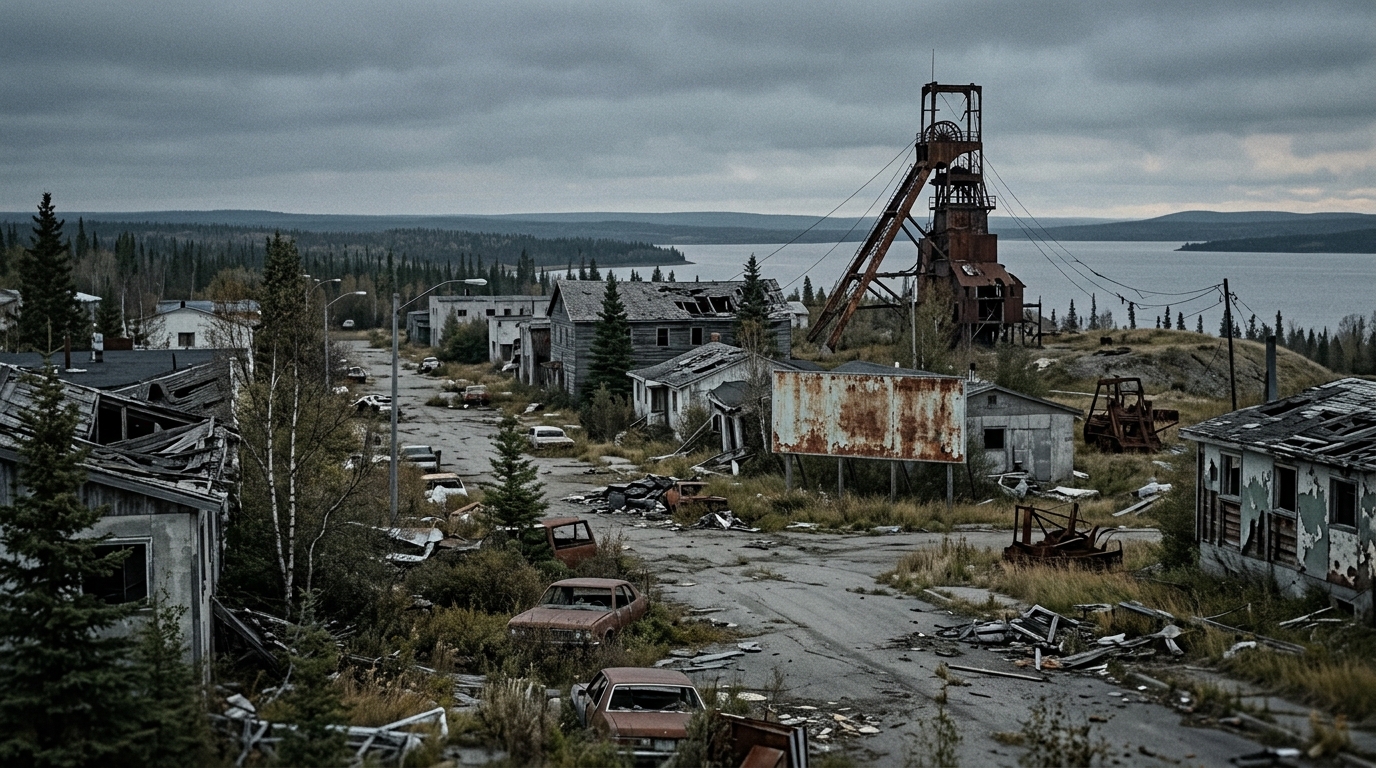
At the northern edge of Saskatchewan, on the north shore of Lake Athabasca, there is a community that could hardly be more different from the prairie cities most people associate with the province.
Uranium City sits about 724 kilometres northwest of Prince Albert, only 48 kilometres south of the Saskatchewan–Northwest Territories border. There is no all-season road connecting it to the rest of the province. The settlement is reached by air, with the immense Lake Athabasca and the northern boreal landscape separating it from the rest of Saskatchewan.
It is also a town that exists because of uranium. That history is written into almost everything around it.
A town built for the nuclear age
Uranium deposits had been identified in northern Saskatchewan before the Second World War, but the federal government restricted private exploration once the strategic importance of uranium became clear. After the war, exploration resumed, and the Athabasca region became the scene of an intense uranium rush. Eldorado Mining and Refining, a federal Crown corporation, became central to the development of the industry.
The discoveries around Beaverlodge Lake transformed the region.
Systematic exploration in the mid-1940s identified hundreds of radioactive showings, while the lifting of restrictions on private prospecting in 1948 triggered a major staking rush. The Beaverlodge district quickly filled with mines, prospectors, camps and transportation routes.
Uranium City was created to give this scattered mining district a permanent centre.
Construction began in 1952. The Saskatchewan government envisioned a planned community rather than the collection of improvised mining settlements that had appeared around earlier northern mines. The town was designed in part along the model of Arvida, Quebec, another planned industrial community.
For a time, it worked.
By 1958, more than 5,000 people lived in the Uranium City and Beaverlodge area, including workers and families living at individual mine sites. Uranium City had schools, shops, government services, housing and the infrastructure required to support a substantial northern population.
The town had appeared remarkably quickly because the industry around it had appeared remarkably quickly.
The Beaverlodge mines
Uranium City was not a mine in itself. It was the centre of a much larger mining district.
The most important operations included Eldorado’s Ace-Fay-Verna complex and the Gunnar mine. The Ace-Fay-Verna operation began production in 1953, while Gunnar began production in 1955. Gunnar alone eventually included an enormous open pit, an underground mine extending roughly 600 metres below the surface, a uranium mill, processing facilities and a company settlement of its own.
Gunnar is about 25 kilometres southwest of Uranium City, on the north shore of Lake Athabasca.
The scale of what was left behind is difficult to reconcile with the word “ghost town.” Gunnar’s former operation included an open pit more than 100 metres deep and approximately 4.4 million tonnes of tailings. The mine operated from 1955 until 1963 and was officially closed in 1964, with little decommissioning at the time.
Other abandoned mines and exploration sites surround Uranium City. Saskatchewan Research Council identifies 35 satellite uranium mine and exploration sites in the area alone, separate from the major mill and mine complexes. Many have required extensive remediation, including sealing shafts and underground openings, removing structures and dealing with mining debris.
This is an important part of the real Uranium City story. The abandoned landscape is not simply an abandoned town. It is an abandoned industrial region.
The nuclear legacy
The uranium industry left behind something more complicated than empty buildings.
Mining and milling produced waste rock and tailings, and some of those materials remain part of the environmental history of the district. The former Lorado mill, approximately eight kilometres south of Uranium City, operated from 1957 to 1960. Its tailings covered about 14 hectares, with an estimated 227,000 cubic metres of material, including approximately 50,000 cubic metres within Nero Lake. The site was remediated in 2016 and remains under monitoring.
The Gunnar site has required an even larger remediation effort.
These places are a reminder that the nuclear age did not end when a mine closed. Its physical consequences remain in the landscape and require management decades later. The Saskatchewan Research Council’s Project CLEANS program has been responsible for the cleanup of dozens of abandoned uranium mine sites around Uranium City.
That history gives Uranium City a very particular place in Canada’s northern landscape. It is simultaneously a mining town, a Cold War town, a chapter in Canada’s nuclear history and an environmental remediation site.
When the mines stopped
Like many single-industry communities, Uranium City was vulnerable to changes far beyond its control.
The uranium market rose and fell repeatedly. The district experienced an early boom, a severe downturn in the 1960s, another period of increased demand, and further instability as uranium production outpaced the market. Eldorado announced cutbacks in 1969, and by 1971 the company was close to shutting down because of uranium stockpiling. The market recovered somewhat in the 1970s, giving the community another period of activity.
Then came the final decline.
Eldorado Nuclear announced the closure of the Beaverlodge operation in 1981. The mine shut down in 1982, effectively ending the industrial foundation on which Uranium City had been built. The population collapsed soon afterward.
The town did not disappear completely.
People still live there. Uranium City remains a northern settlement, with an airport and basic services, and the surrounding country remains very much alive. The forest, lakes and wildlife did not leave when the miners did.
That distinction matters.
Uranium City is often described as a ghost town, but it is more accurately a community that survived the disappearance of the industry that created it.
Uranium City today
The physical setting is part of what makes the place so distinctive.
There is Lake Athabasca, one of Canada’s great northern lakes, stretching away from the settlement. There is boreal forest, exposed rock, old mine workings and the remains of an industrial landscape that was built at remarkable speed during the 1950s.
There are also the traces of the town’s more ambitious years.
Uranium City was not thrown together as a temporary camp and forgotten. It was intended to be a permanent northern community. Houses, public buildings, roads and services were constructed for thousands of people because the uranium industry appeared capable of sustaining them.
For a few decades, it did. Then the economic reason for the town’s existence disappeared.
That is what makes the place so interesting today. The landscape preserves the difference between a community designed for a future that arrived and one designed for a future that eventually ended.
Uranium City in Warriors of the Last Days
A story currently in progress takes Warriors of the Last Days into Uranium City.
The location provides a very different northern Saskatchewan setting from The Front, which brings the series into the prairie landscape around Saskatoon. Uranium City belongs to another Saskatchewan entirely: the country around Lake Athabasca, the boreal forest, the old mining district and the northern edge of the province.
Its place in the lore of Warriors of the Last Days comes from that history. The Collapse did not create Uranium City’s abandoned landscape. The nuclear age did.
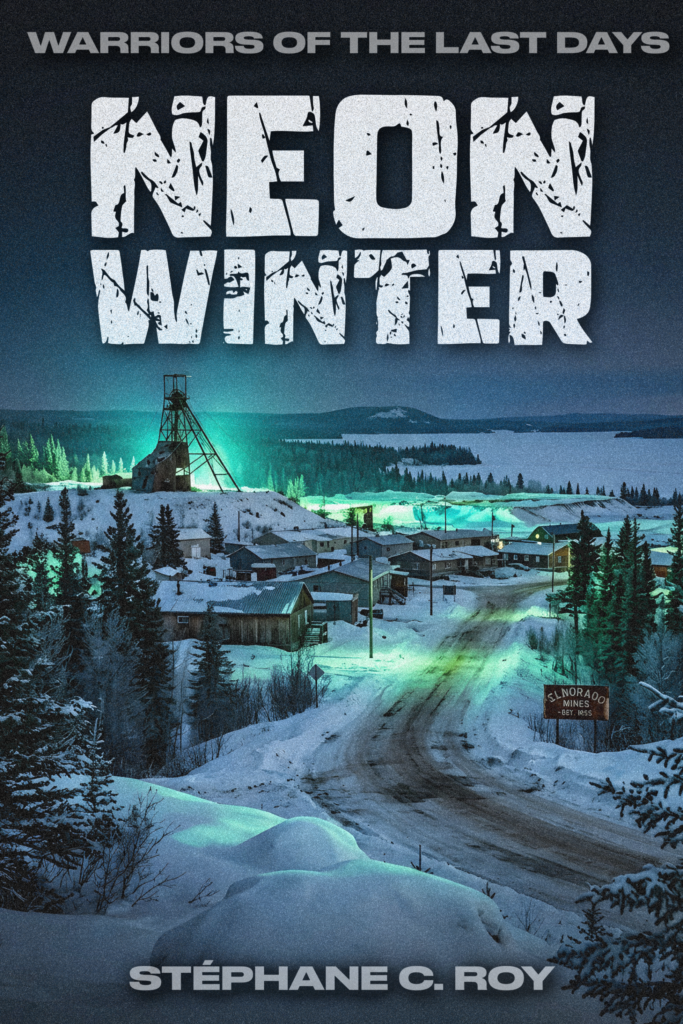
The mines, tailings, abandoned industrial sites and scattered remnants of the Beaverlodge district all existed before the Light. The story therefore enters a place where abandonment, extraction and the legacy of uranium were already part of the landscape.
What happens there belongs to the fictional world of Warriors of the Last Days. The setting does not.
That is the appeal of Uranium City. It does not need to be turned into a post-apocalyptic place. Its real history has already left behind almost everything a post-apocalyptic story needs: a remote northern community, a vanished industry, abandoned mines, a landscape altered by extraction and a town built during the nuclear age that outlived the reason for its existence.
The Light simply gives that history another chapter.
A new post-apocalyptic story from Canada. Every month.
The earlier you join, the larger your library becomes.
Join now. Start building your library before the next hundred.
 Stéphane Roy is a lifelong reader and writer with a deep love for science fiction, apocalyptic worlds, and tightly constructed mysteries. This is his first novel. He lives in the Yukon with his dog and his aquarium, where long winters, silence, and wide, sometimes glowing, skies leave plenty of room for imagining the end of the world, and what might come after it. He is also waiting, with cautious optimism, for the aliens to finally reveal themselves and straighten us all out.