
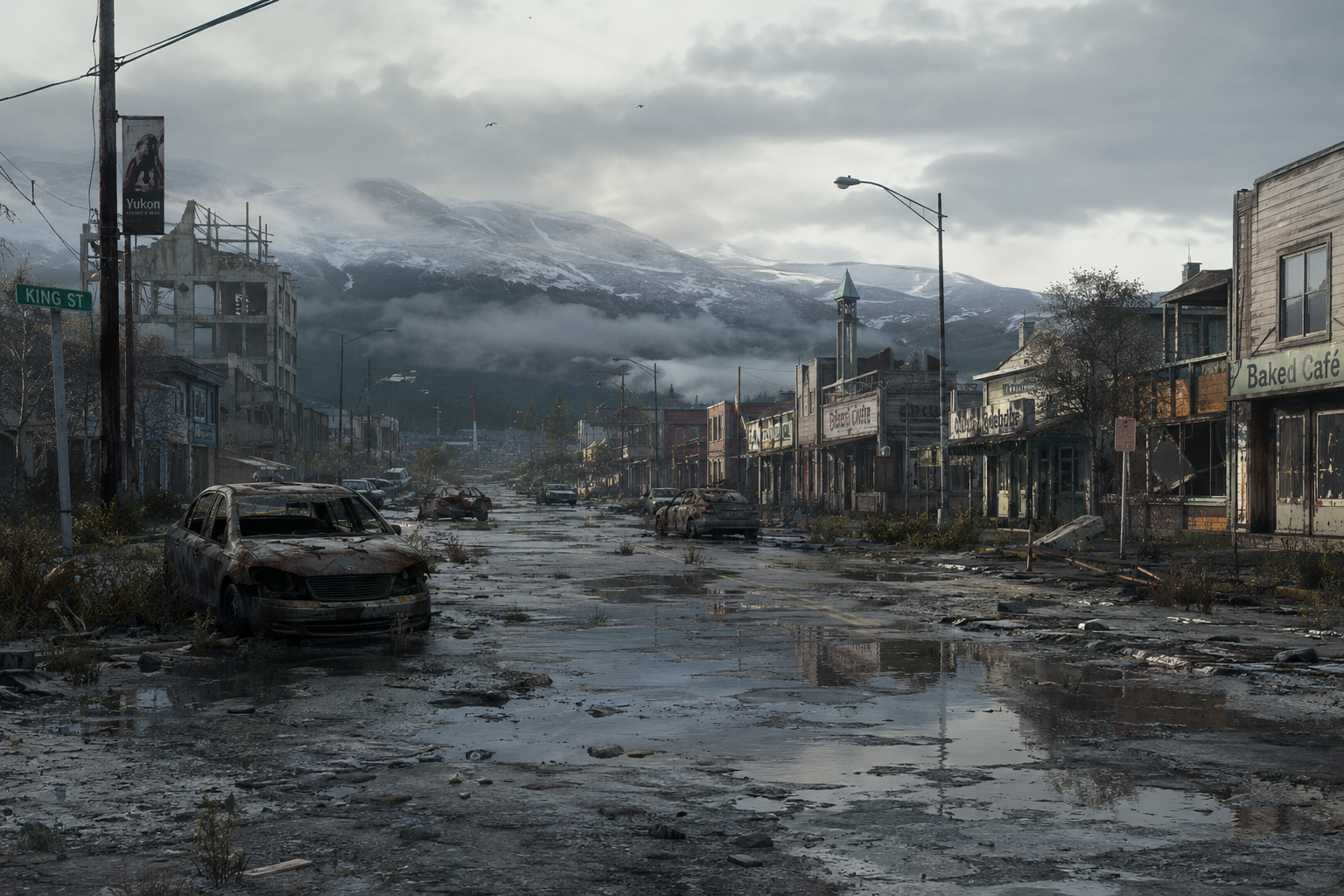
Post-Apocalyptic Fiction in the Yukon: Survival at the Edge of the Map
When readers picture the apocalypse, they tend to picture cities.
New York buried in ash. Los Angeles consumed by drought. Chicago frozen beneath snow.
The Yukon offers something different. Not a civilization transformed by collapse, but a place where the conditions collapse creates already exist. Vast distances between communities. Roads that determine whether people stay connected or don’t. Winters that don’t negotiate.
That combination makes the Yukon one of the most naturally suited post-apocalyptic settings in North America, and one of the least explored.
Time for more post-apocalyptic fiction in the Yukon.
Why the Yukon Works Before Anyone Writes a Single Word
Most survival fiction requires setup. The writer has to explain why the city is now dangerous, why food is scarce, why travel has become difficult.
The Yukon skips most of that.
The territory covers nearly half a million square kilometres with a population smaller than many city neighbourhoods. Communities are separated by hundreds of kilometres. A broken bridge can isolate an entire region. A delayed shipment affects whole towns. Fuel, food, and medical supplies travel enormous distances before reaching anyone.
People there understand infrastructure because they see its limits every day.
For fiction writers, that means the transition from civilization to collapse requires almost no explanation. The reader already believes it.
The Geography of Survival
Whitehorse is the only city that matters in a collapsed Yukon.
It contains transportation infrastructure, government facilities, medical services, and access to the Yukon River system. In a world where national governments no longer function, it becomes something more specific: a place where people can still organize.
Any serious post-apocalyptic fiction in the Yukon story eventually has to reckon with it.
The Alaska Highway matters for a different reason. Stretching through wilderness and connecting communities across enormous distances, it becomes a trade route, migration corridor, and strategic objective simultaneously. Many post-apocalyptic novels invent roads like this. The Yukon already has one.
The Yukon River predates the highway by centuries. Before roads existed, rivers connected people. In a collapse scenario, they do again. Transportation networks, food sources, natural corridors between settlements. The farther technology recedes, the more valuable waterways become.
Winter ties all of it together. A failed heating system isn’t an inconvenience. It’s a crisis. A damaged shelter isn’t a setback. Every decision about food storage, fuel reserves, shelter, clothing, and travel runs through the cold. Unlike most antagonists in post-apocalyptic fiction, winter doesn’t escalate dramatically. It just waits.
The Literary Foundations
The Yukon already had a survival literature long before post-apocalyptic fiction arrived.
The Klondike Gold Rush built a mythology around endurance, isolation, hardship, and weather. Writers like Jack London established the North as a place where nature couldn’t be ignored and survival was never guaranteed. That tradition didn’t disappear. Modern Yukon apocalypse stories inherit it, sometimes consciously, sometimes not.
The world may have ended. The landscape remains recognizably northern.
The Novels—post-apocalyptic fiction in the Yukon
Tyrell Johnson’s The Wolves of Winter is the strongest existing example. Set after biological warfare and societal collapse, it follows a family surviving in the Yukon wilderness. The territory shapes every decision: food, distance, weather, geography. Johnson doesn’t use the landscape as backdrop. It’s an active force.
Tao Wong’s Life in the North, the first book in his System Apocalypse series, takes a different approach. The story applies LitRPG mechanics to post-collapse Whitehorse, with characters gaining skills and levels as society rebuilds. It’s a different register than grounded collapse fiction, but its focus on reconstruction rather than pure survival fits the Yukon context. The question the series keeps asking is what comes after endurance.
The Warriors of the Last Days Yukon Stories
Two short works in the Warriors of the Last Days series are Post-Apocalyptic Fiction in the Yukon, each approaching collapse from a different angle.
The Toe takes place in post-collapse Dawson City. Edouard Marsh loses his right big toe to a wolverine while checking trap lines. Knowing the toe is gone regardless, he decides it belongs in the Sourtoe Cocktail tradition at Dawson City’s historic saloon, and spends days tracking the wolverine across the wilderness to recover it before making the donation himself. The Collapse hasn’t ended the tradition. People still care enough to maintain it.
Special Delivery follows Gary Mallet, a Dawson City mail carrier who continues running deliveries along the Dempster Highway years after the Collapse. His route covers Dawson City, Eagle Plains, Fort McPherson, Tsiigehtchic, and Inuvik, eventually extending far beyond his normal responsibilities toward Grise Fiord in Nunavut. The catalyst is a single postcard. Gary’s decision to complete the delivery reflects one of the story’s central ideas: obligations outlast the institutions that created them.
Cold Storage, the upcoming novel (release 2027), expands the Yukon storyline. Set during a particularly harsh post-apocalyptic winter in Dawson City, it follows communities adapting to life after collapse while confronting threats emerging from beneath thawing permafrost.
SYNOPSIS
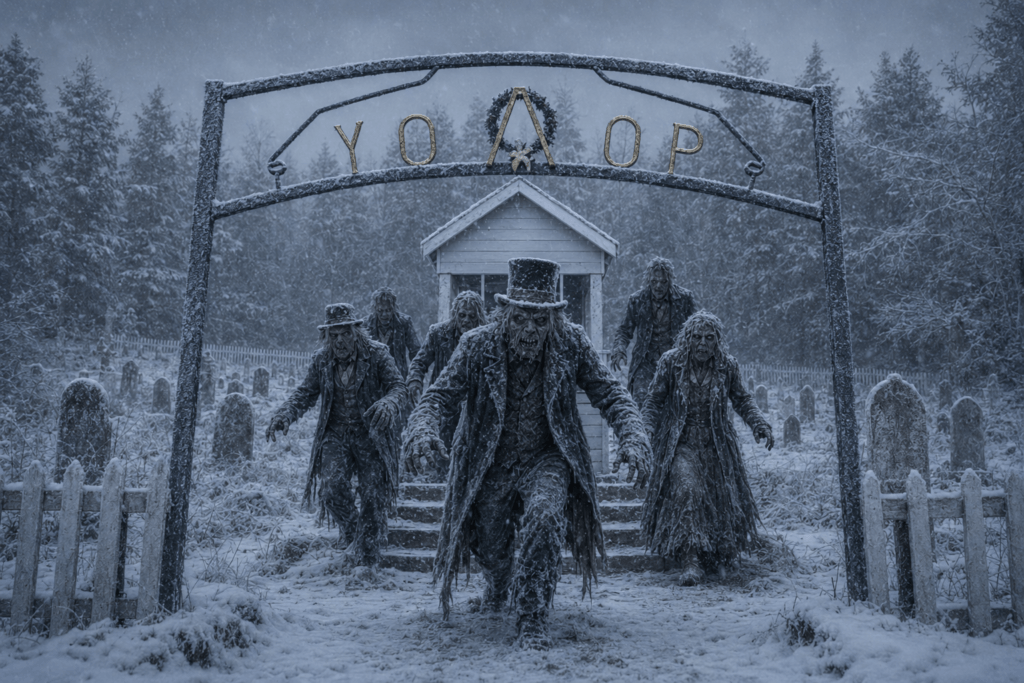
Thirty years after the Light, the Yukon sky turned green on the eve of Christmas. Then, the dead woke up.
Three decades of isolation have turned Dawson City into a hard, stubborn relic of the old world. Inside the Sourdough Saloon, before Christmas, the town handles a different kind of crisis: a lack of survivors and the disparition of any postal service have left the legendary sourtoe jar completely empty, threatening to kill a century-old Klondike tradition. Edouard Marsh, a meticulous local who long ago sacrificed his own digit to the jar, can only watch as the frontier loses another piece of its history.
But the Yukon isn’t done with them yet.
That night, a freak atmospheric event unleashes a violent aurora borealis across the northern territory. The energetic green sky ionizes the air, activating thirty years of accumulated radioactive fallout packed deep inside the Yukon Orders of Pioneers (YOOP) cemetery. Out of the shattered permafrost rise The Frozen Damned, brittle, freezer-burned ghouls from 1898 with wood-bark skin and muscle dense as cured leather. Driven by a chemical, heat-seeking aggression, they swarm the settlement in a desperate hunt for living thermal energy and moisture. Warm blood will do just fine.
To survive the night, Dawson City must wage a visceral, all-night war with axes and fuel-oil fires against a horde that doesn’t bleed and does not behave like traditional zombies. But when the green sky fades and the living stand among mountains of shattered, frozen carapaces, Edouard realizes the battle is only the beginning. Because a true Klondiker never lets a resource go to waste.
What Yukon Stories Do Differently
Many post-apocalyptic stories feature characters learning survival after disaster strikes. Yukon fiction tends to begin with people who already know how. They hunt, trap, maintain equipment, read weather, and understand isolation. The challenge isn’t acquiring those skills. It’s applying them to circumstances that keep changing.
Individual survival is also a less prominent theme than in most American post-apocalyptic fiction. Small communities depend on cooperation. Resources are shared, knowledge is exchanged, infrastructure is maintained collectively. Success comes through participation. Lone survivors don’t tend to fare well.
The persistence of tradition is the most striking theme. The Sourtoe Cocktail survives. Mail routes survive. Community rituals survive. People continue doing things because those things mattered before the collapse and still matter after. The stories become less about the end of civilization and more about what civilization actually consists of.
Why the Yukon Deserves More
Canada has produced strong post-apocalyptic fiction, but most of it focuses on Ontario, Quebec, or broad national collapse. The Yukon remains comparatively unexplored.
That’s a gap, because the territory offers nearly everything the genre requires: isolation, difficult terrain, strategic infrastructure, extreme weather, and communities that rely on one another by necessity.
It’s a setting where survival feels believable because survival was already part of daily life.
Readers looking to go deeper into Canadian post-apocalyptic fiction can explore the broader tradition, including Waubgeshig Rice’s Moon of the Crusted Snow, which examines collapse through an Anishinaabe community in Northern Ontario, and the comparable titles connected to the Warriors of the Last Days series.
Post-Apocalyptic Fiction in the Yukon
Do you know of other Post-Apocalyptic Fiction in the Yukon? If you do, we would absolutely love to hear about them! Do not hesitate to share them with us!
© Copyright 2026 WARRIORS OF THE LAST DAYS All rights reserved Privacy Policy
- Post-Apocalyptic Fiction in the Yukon: Survival at the Edge of the Map
- Why the Yukon Works Before Anyone Writes a Single Word
- The Geography of Survival
- The Literary Foundations
- The Novels—post-apocalyptic fiction in the Yukon
- The Warriors of the Last Days Yukon Stories
- COLD STORAGE SYNOPSIS
- What Yukon Stories Do Differently
- Why the Yukon Deserves More
 Stéphane Roy is a lifelong reader and writer with a deep love for science fiction, apocalyptic worlds, and tightly constructed mysteries. This is his first novel. He lives in the Yukon with his dog and his aquarium, where long winters, silence, and wide, sometimes glowing, skies leave plenty of room for imagining the end of the world, and what might come after it. He is also waiting, with cautious optimism, for the aliens to finally reveal themselves and straighten us all out.