
Editing: How Émile was born
BORN IN EDITING
Some characters arrive fully formed. Others have to fight their way into the story.
Émile was never supposed to matter this much.
In the earliest drafts of Exodus, he was a tertiary character whose primary purpose was practical. He was young, enthusiastic, and knew Francon well enough to explain things to Andy. He appeared in a handful of scenes, provided context when needed, and then faded into the background. He did his job.
At the same time, there was another minor character called Quiet Hands.
Quiet Hands appeared much later in the story. He existed mostly because the plot needed someone to make a difficult choice and perform a specific function near the end. He had a memorable nickname and a role to play, but very little else. From a craft perspective, he was useful. As a character, he was mostly empty.
During editing, I started looking at both characters and realized they occupied the same narrative space. One disappeared early. The other appeared late. Neither had enough substance to justify existing independently.
So I merged them.
Émile became Quiet Hands.
OVERTIME THE MERGED CHARACTERS BECAME SOMETHING ELSE
At first, it was simply an exercise in efficiency. Fewer characters mean fewer names for readers to remember. It also allowed a relationship to develop between Andy and Émile over a longer stretch of the story. Instead of one character disappearing and another appearing, the same person remained present throughout the journey.
What happened next was completely unexpected.
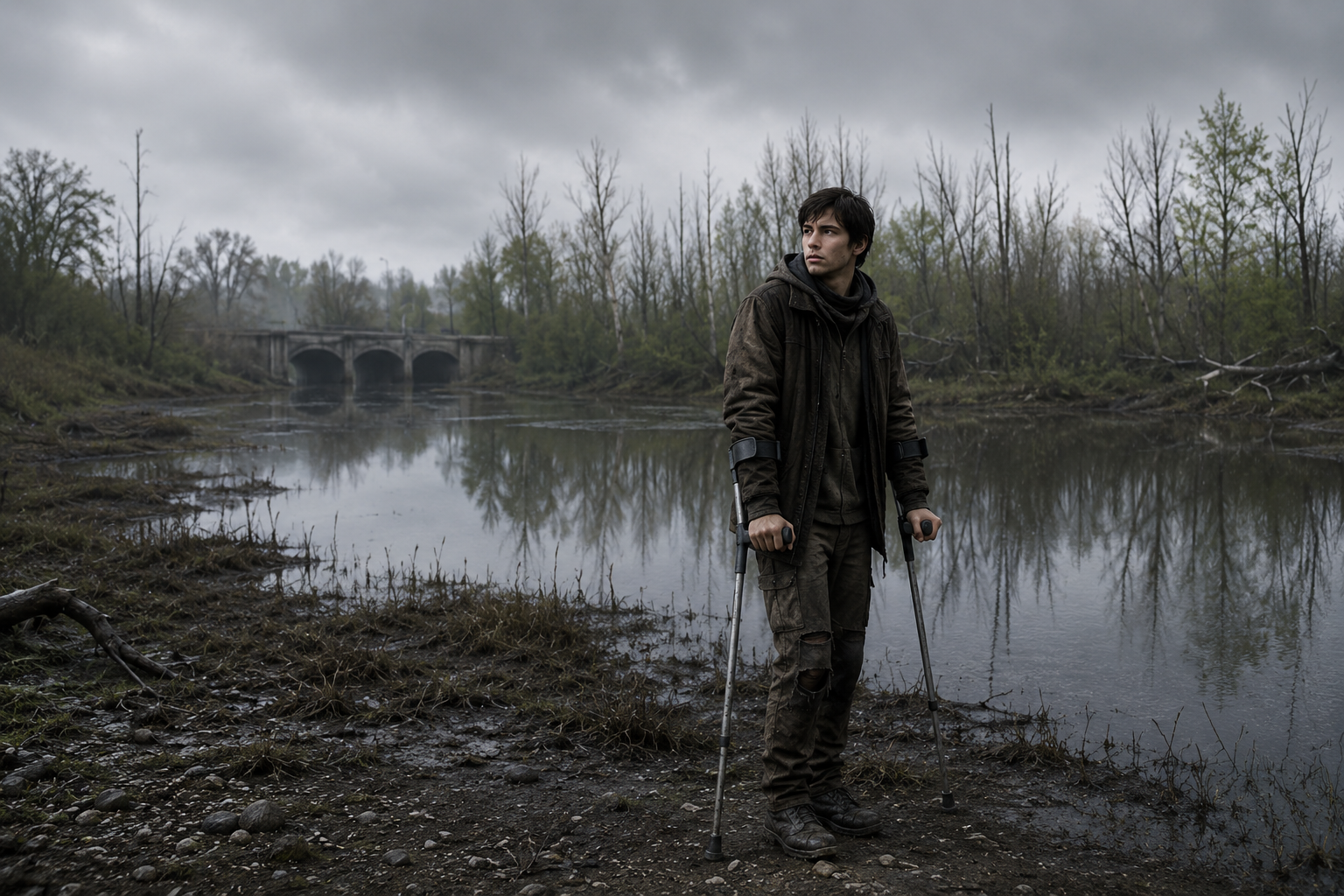
Because of the nature of Francon itself(and without venturing too far into spoiler territory), Émile became one of the children born during the Fell, the difficult years that followed the Light. Exposure to fallout radiation left that generation with severe calcium deficiencies and brittle bones. Most did not survive childhood.
Émile did.
Physically, however, he never recovered. His bones fractured easily. His body could never meet the expectations Francon placed on its people.
That single change transformed him.
DISIEASE AS AN ICON FOR LOSS
Suddenly, he wasn’t merely a guide for Andy. He became someone trapped between the needs of the community and the limitations of his own body. In a settlement built around labour, contribution, and sacrifice, Émile could not carry his share the way others could.
Worse, he became a reminder.
The adults of Francon had buried children from his generation. Every time they looked at Émile, they were forced to remember losses they would rather leave in the past. And they let it know. Not always obviously, not always maliciously. But the resentment was real.
THE NICKNAMES
The nickname Quiet Hands came from an old joke.
As Émile explains in the novel, he once tried helping to build a house. He swung a hammer, struck a nail, and broke his arm in the process.
“My arm snapped when I hit the nail. Made more noise than the hammer did.”
People laughed. Somebody called him Quiet Hands.
The name stuck.
On the surface, it was harmless. One of those nicknames communities invent and never let go.
Others, meaner ones, took to call him Cap. Not Cap as in Captain, despite their fishing economy. Cap, as in Handicapped.
Over time something interesting happened.
People stopped calling him Émile.
They called him Quiet.
Or Quiet Hands. Or Cap.
The nicknames remained. The person underneath it slowly faded.
Then Andy arrived.
One of the smallest moments in the story became one of the most important. Andy simply called him Émile.
Not Quiet.
Not Quiet Hands.
Émile.
A simple act. A name. Nothing more.
Yet that moment became the foundation of a friendship and, eventually, one of the emotional pillars of the novel.
A FASCINATING EXPERIENCE
Looking back, it’s strange how insignificant the change seemed at the time. Two minor characters became one. A few scenes were adjusted. Some dialogue moved around.
But the result was far larger than the edit itself.
The merged character became central to Francon’s story, central to Andy’s development, and central to some of the emotional choices that follow. Entire scenes gained weight because Émile existed in them. Relationships became more meaningful. Departures became more painful. Choices became harder.
Most importantly, the story started asking different questions.
What happens to someone whose community no longer knows what to do with them?
What happens when a person’s value can no longer be measured by what they can contribute?
What does it mean to remain hopeful when everyone sees you as a reminder of something broken?
None of those questions existed when Émile and Quiet Hands were separate characters.
They only appeared after the merge.
As a first-time novelist, this was one of the most surprising experiences of the editing process. I had always imagined that major discoveries happened during drafting. By the time editing began, I assumed the story’s biggest surprises were behind me.
Instead, one of the most important characters in the book emerged after I thought the novel was already finished.
Émile wasn’t planned.
He wasn’t outlined.
He wasn’t designed to become the emotional center of multiple storylines.
He simply grew into the space the story needed him to occupy.
And now, looking back at earlier drafts, it’s difficult to imagine Francon (or Exodus itself) without him.
The key change is that the nickname is no longer presented as overt rejection. It starts as a genuine community nickname, which feels more believable. The emotional weight comes from the gradual replacement of his real identity, not from deliberate cruelty. That ambiguity tends to hit harder.
© Copyright 2026 WARRIORS OF THE LAST DAYS All rights reserved Privacy Policy
 Stéphane Roy is a lifelong reader and writer with a deep love for science fiction, apocalyptic worlds, and tightly constructed mysteries. This is his first novel. He lives in the Yukon with his dog and his aquarium, where long winters, silence, and wide, sometimes glowing, skies leave plenty of room for imagining the end of the world, and what might come after it. He is also waiting, with cautious optimism, for the aliens to finally reveal themselves and straighten us all out.