The Self-Imposed Challenge of Writing Canada’s Oddest Places
Every once in a while, a writer gives themselves a stupid problem and then has to solve it.
Ours started with a question that sounded almost like a joke: what if every story we wrote had to take place somewhere whose name alone makes people stop and try it out loud? Not a city you can find on a highway sign in a single glance. Not a place your browser autocomplete solves for you. Somewhere that makes the mouth work before the brain does. Somewhere strange enough, odd enough, or just genuinely difficult enough that naming it becomes part of the story.
We didn’t plan it as a series. It started as a lark. Then it became a row.
The Lake That Refuses to Be Said
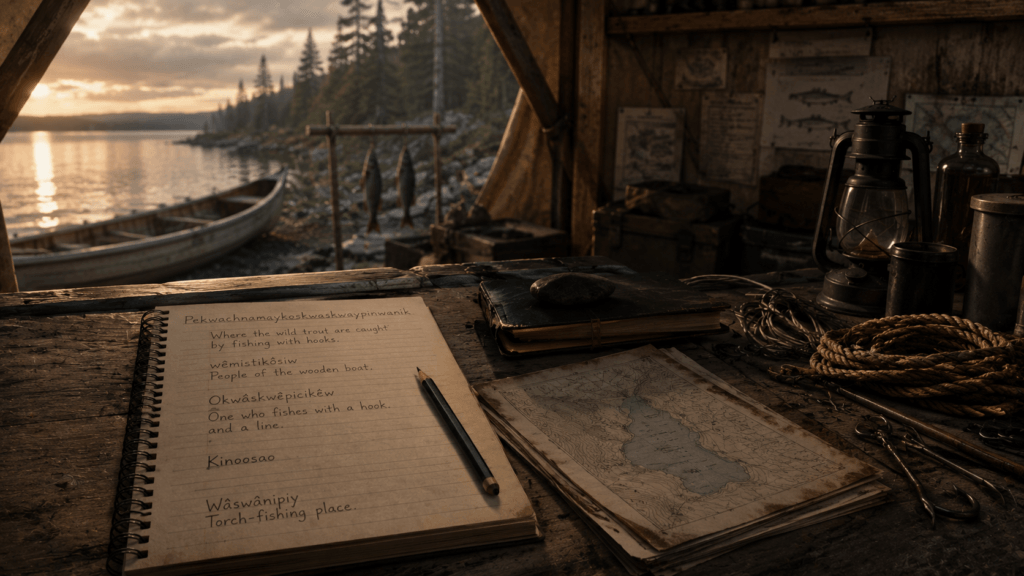
The first one was Towing the Line. The setting was Pekwachnamaykoskwaskwaypinwanik Lake, Manitoba: thirty-one letters, the longest place name in Canada, a name whose meaning (“where the wild trout are caught by fishing with hooks”) has nothing to do with what happens on its surface. The story is told by a government surveyor trying to document a community that the rest of the country forgot after the collapse. He writes the name down every time he uses it. The name does not belong on paper. The lake tolerates no memory, and by the end of the story, neither does he.
We picked that place on purpose. Not because it’s haunted. Not because there’s a monster in it. But because a name that long, in a story that short, forces the reader to slow down. You can’t skim it. You have to say it to yourself. There’s something about the act of pronunciation that makes a place feel occupied.
A Town Named After a Dream
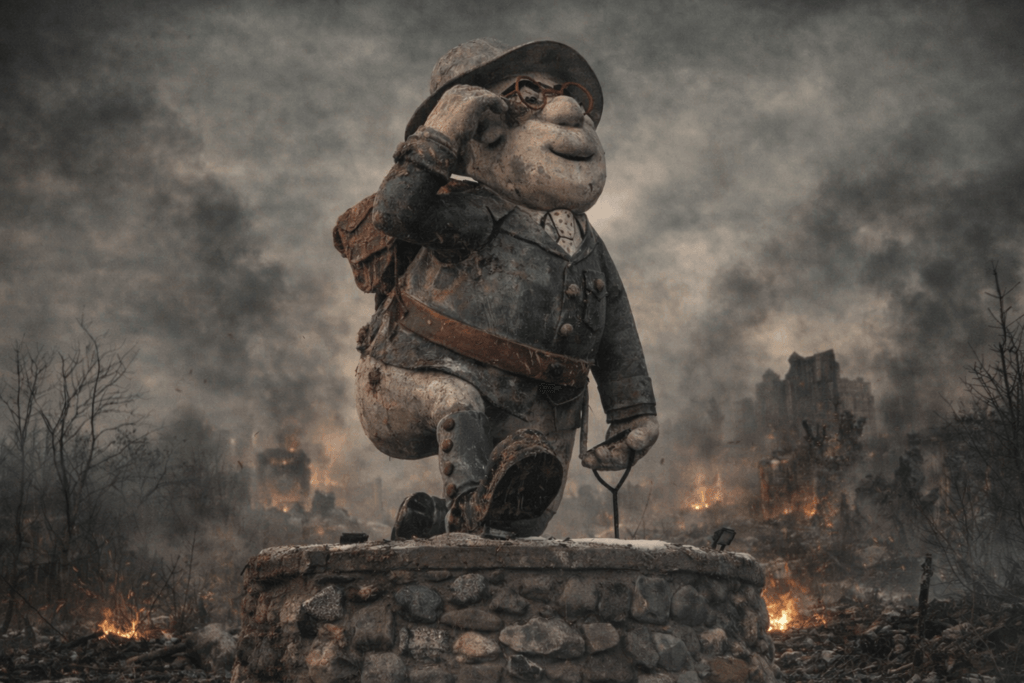
Then came the Flin Flon triptych: Flin Flon’s Hole, The Expected, and the still-withheld The Sunless City. Flin Flon, Manitoba, is a mining town named after a fictional character from a 1909 science fiction novel: the character was named after a similarly fictional prospector from an earlier novel, so the place was already carrying a layer of unreality before we ever put a post-collapse story on it. The town sits on the border of Manitoba and Saskatchewan, built into rock that the mining operations have been chewing through for decades. In our stories, the rock opens into something that has been waiting down there for sixty-five million years.
The triptych started as a single story. It grew into three. The middle piece, The Expected, follows a precise assessor who has started dreaming in a language she doesn’t know, returning alone to a sealed chamber beneath the mine. The ending was deliberately withheld pending a major rewrite, not because it wasn’t written, but because it wasn’t right yet. Some stories you withhold not because they aren’t done, but because the place they’re set in demands more than you’ve managed to give it.
The Town With Two Exclamation Marks
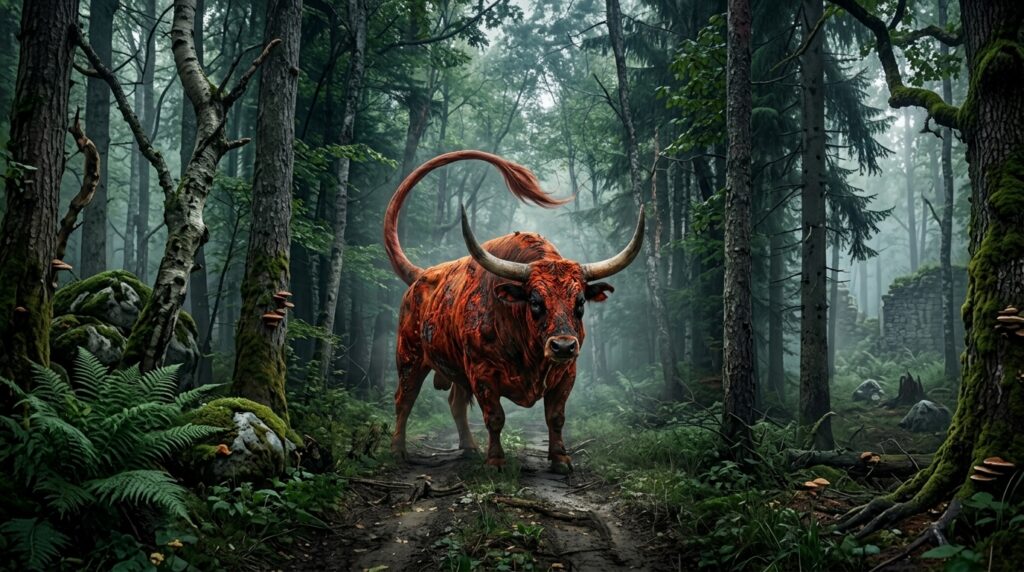
The Long Tailed Beast is set in Saint-Louis-du-Ha! Ha!, Quebec, the only town on Earth, according to Guinness, whose name contains two exclamation marks. The place is real. It sits on a plateau in the Témiscouata region, surrounded by lakes and an old portage route that predates roads. The folktale we anchored it to, La Bête à Grand’Queue, the Big-Tailed Beast from Honoré Beaugrand’s 1900 collection La Chasse galerie, is itself a creature with a six-foot tail and fire eyes that menaces anyone who goes seven years without confession. The story isn’t written yet. We’ve got three different approaches on the table and none of them fully fit. Sometimes that’s the place telling you it wants something you haven’t figured out how to give it yet.
A Fishing Village at the End of the Road
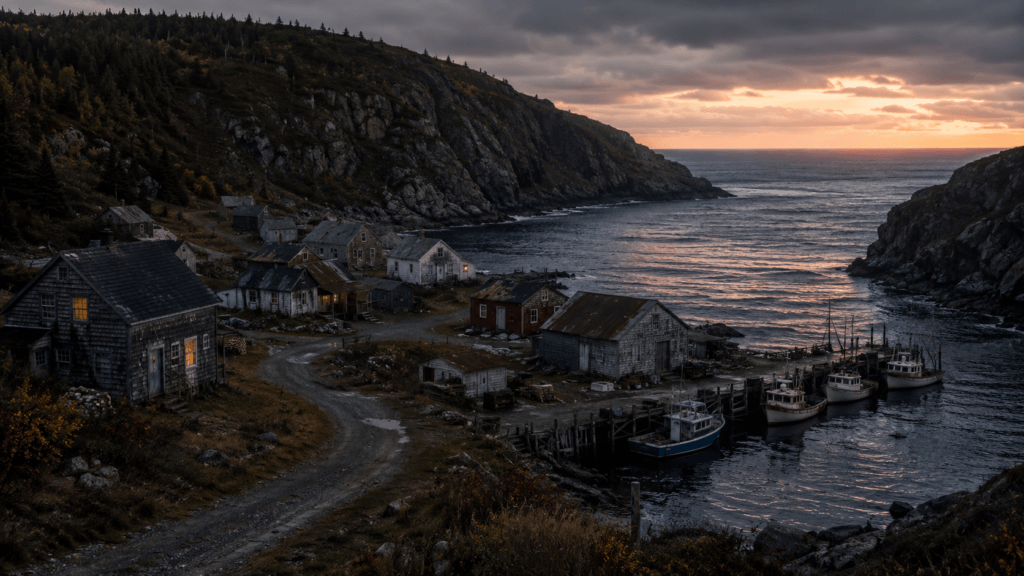
Meat Cove, Nova Scotia, is the real name of a tiny fishing village at the northern tip of Cape Breton Island, at the end of the Cabot Trail. The name is what it is. The story is a standalone horror piece: unnamed protagonist, third person, no cycle attachment, no grand mythology to plug it into. Sometimes the oddest places are the ones that resist being part of anything larger. Meat Cove doesn’t want to be a chapter in a bigger book. It wants to be its own single, strange thing.
The Coldest Places in North America
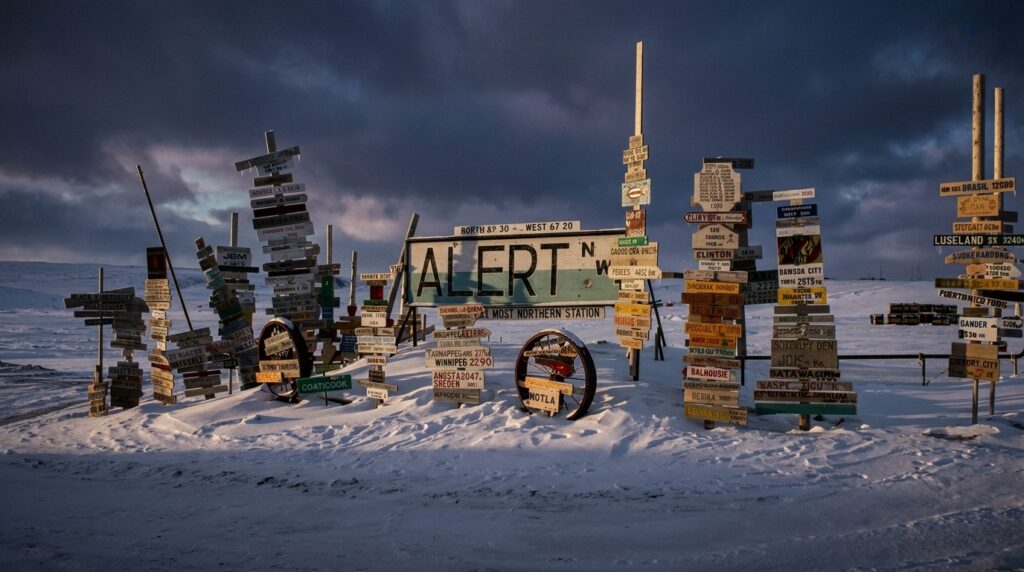
Alert, Nunavut, is the northernmost permanently inhabited place on Earth: a former military base on the northern tip of Ellesmere Island, so far north that the sun doesn’t set for months and doesn’t rise for months. The story set there hasn’t been written yet. But the place itself is already doing the work: a location so extreme that “survivors after the collapse” stops being a premise and starts being the only possible situation.
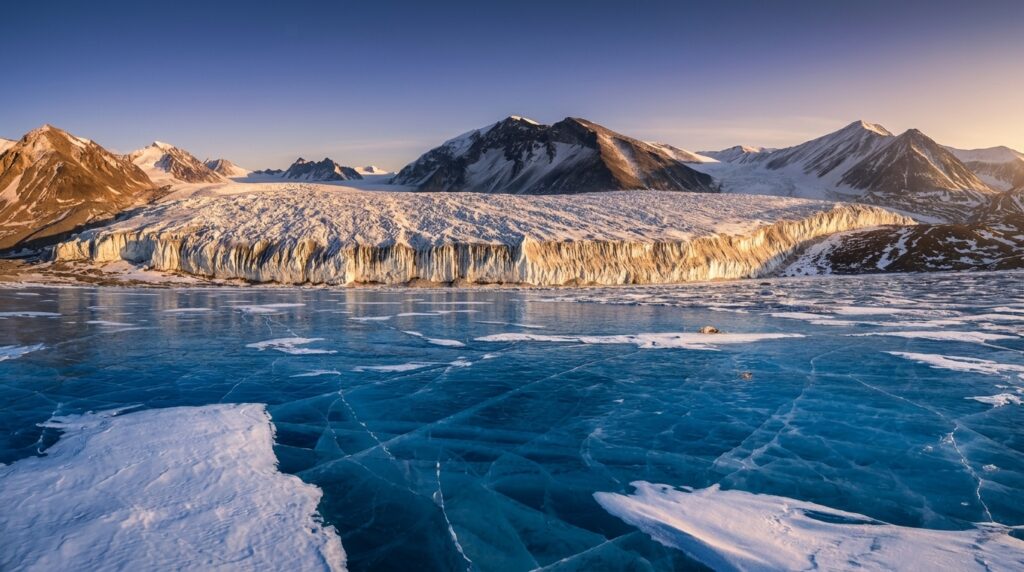
Snag, Yukon, has a similar gravitational pull. It’s a ghost town that holds North America’s all-time cold record: −63°C, February 1947. The town’s name comes from a dead-tree-choked creek, a “snag” in the forestry sense, but the real phenomenon that makes it interesting is what the cold did to sound. On those brutally cold days, acoustic temperature inversions carried voices, dogs, and river-ice cracks for kilometres along the ground. Breath crystallized into frozen mist that lingered. After the apocalypse, in our version of it, that physics becomes permanent. A landscape where making a sound is a death sentence. The story is called The Snag, and the title works on both meanings.
The Ghost Town With No Road
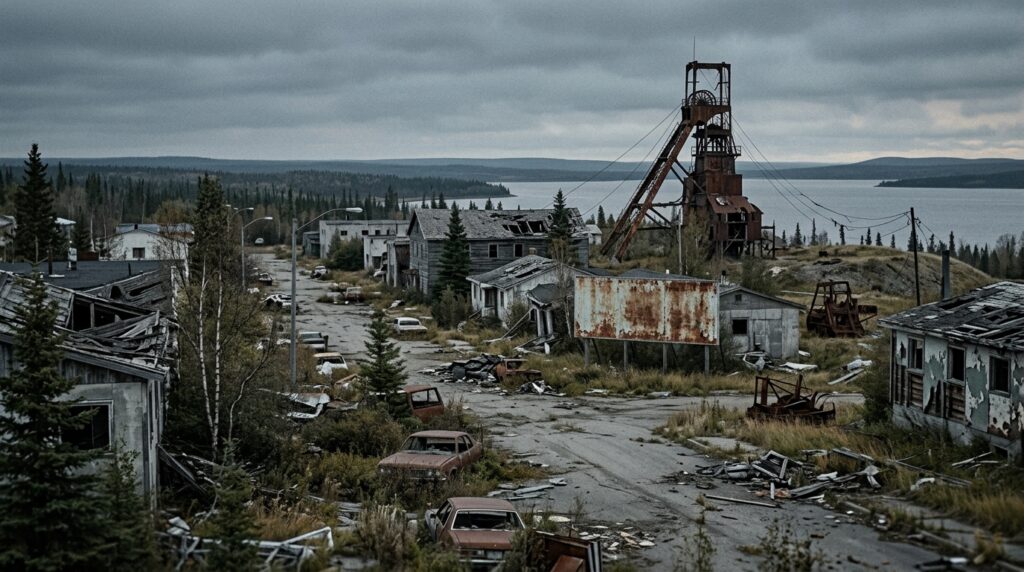
The Neon Winter is set in Uranium City, Saskatchewan, a real fly-in community that had no road connection to the rest of the province and was essentially abandoned after the uranium market collapsed. In our version, decades after the global collapse, the radioactive tailings and flooded mines glow with an unstable bioluminescence. A survivor community lives in the ruins of the old Beaverlodge Mill. The glow is harvested, as power, and as a narcotic. Then the glow starts spreading. Survival horror, cosmic sci-fi, a place that was already disused when the world ended and simply never got the memo.
The Dene Lake That Keeps Its Own Accounts
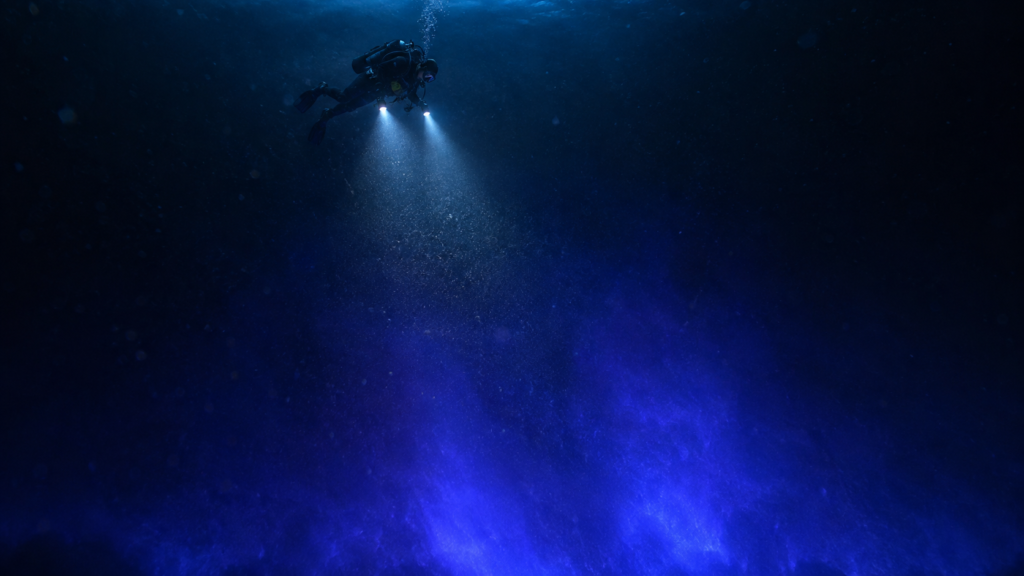
The Sahtúgot, set on Great Bear Lake in the Northwest Territories, is a different kind of uranium story entirely, and it’s the one rooted in a true one. The title comes from the Dene name for the lake. The story follows a nuclear safety inspector sent to investigate an impossible glow rising from the bottom of the water. What she finds is something the local community has known about for generations, long before any government agency showed up to measure it. Her report can’t say what she actually found. The real-world grain here is the Eldorado townsite, the uranium program, and the fact that Great Bear Lake kept its own account of what that cost, long before our story begins. The Neon Winter and The Sahtúgot share a subject. They don’t share a world, a tone, or a kind of truth. One is a ghost town that glows. The other is a lake that never stopped seeing what was done to it.
Places That Have Always Been Strange
The thing about this challenge, and the reason it stuck, is that Canada is full of places whose names predate the English and French speakers who wrote them down. Pekwachnamaykoskwaskwaypinwanik is Cree. Sahtúgot is Dene. The Ijirait story is set on Ellesmere Island, at Grise Fiord, the northernmost civilian community in Canada, and the creature in it is not a mutation but a figure from Inuit folklore that has existed in that landscape long before our post-collapse world did. Adlivun, the Inuit underworld, gives its name to the Baffin Island story about a narwhal with a tusk that glows wrong and looks back at a hunter with something his grandmother’s stories have a name for.
These aren’t just settings. They’re places that were strange before the apocalypse and stay strange after. Some of them have names that resist being said. Some have geographies that resist being crossed. Some were built for a purpose that no longer exists: mine workings, military bases, ghost towns, and the collapse just removed the last justification for staying empty.
Why a Challenge?
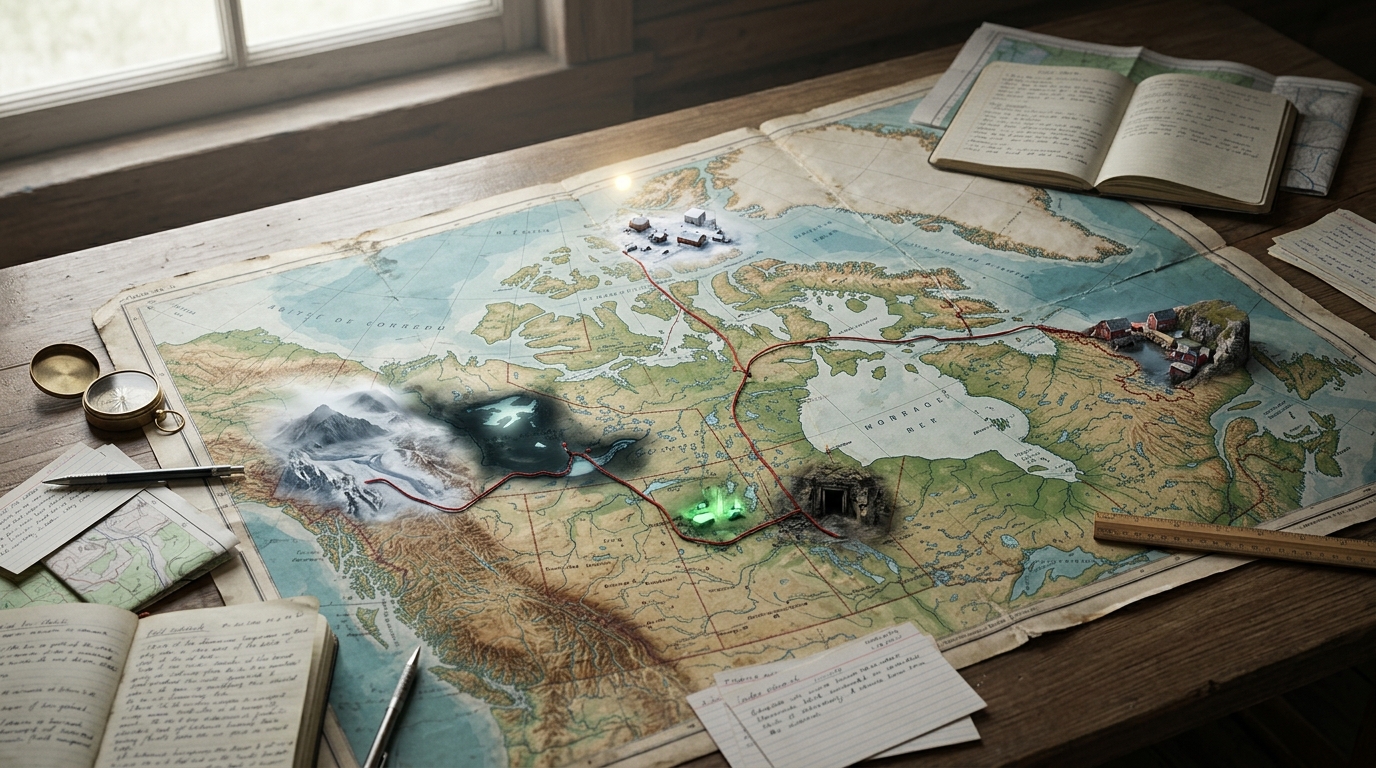
We didn’t set out to build a map. But we kept noticing that the stories wanted to go to places most fiction doesn’t bother with. The sort of places you pass through if you’re driving across the country and only stop when something goes wrong. The sort of places that have history layered into their names whether you’re aware of it or not.
The challenge, as we eventually named it for ourselves, was simple: write the story the place asks for, not the one we came in with. Sometimes that means a thirty-one-letter lake name becomes a story about a man who can’t hold onto his own memories. Sometimes a mining town named after a fictional character becomes a triptych about something a mine opened into the rock. Sometimes a fishing village at the end of a coastal road just wants to be a single sharp horror story and nothing more.
We’re not done. The Long Tailed Beast, Alert, Snag, and The Neon Winter are all still waiting to be written. And the map keeps growing sideways, one strange place at a time.
- The Self-Imposed Challenge of Writing Canada's Oddest Places
- The Lake That Refuses to Be Said
- A Town Named After a Dream
- The Town With Two Exclamation Marks
- A Fishing Village at the End of the Road
- The Coldest Places in North America
- The Ghost Town With No Road
- The Dene Lake That Keeps Its Own Accounts
- Places That Have Always Been Strange
- Why a Challenge?
A new post-apocalyptic story from Canada. Every month.
The earlier you join, the larger your library becomes.
Join now. Start building your library before the next hundred.
 Stéphane Roy is a lifelong reader and writer with a deep love for science fiction, apocalyptic worlds, and tightly constructed mysteries. This is his first novel. He lives in the Yukon with his dog and his aquarium, where long winters, silence, and wide, sometimes glowing, skies leave plenty of room for imagining the end of the world, and what might come after it. He is also waiting, with cautious optimism, for the aliens to finally reveal themselves and straighten us all out.