
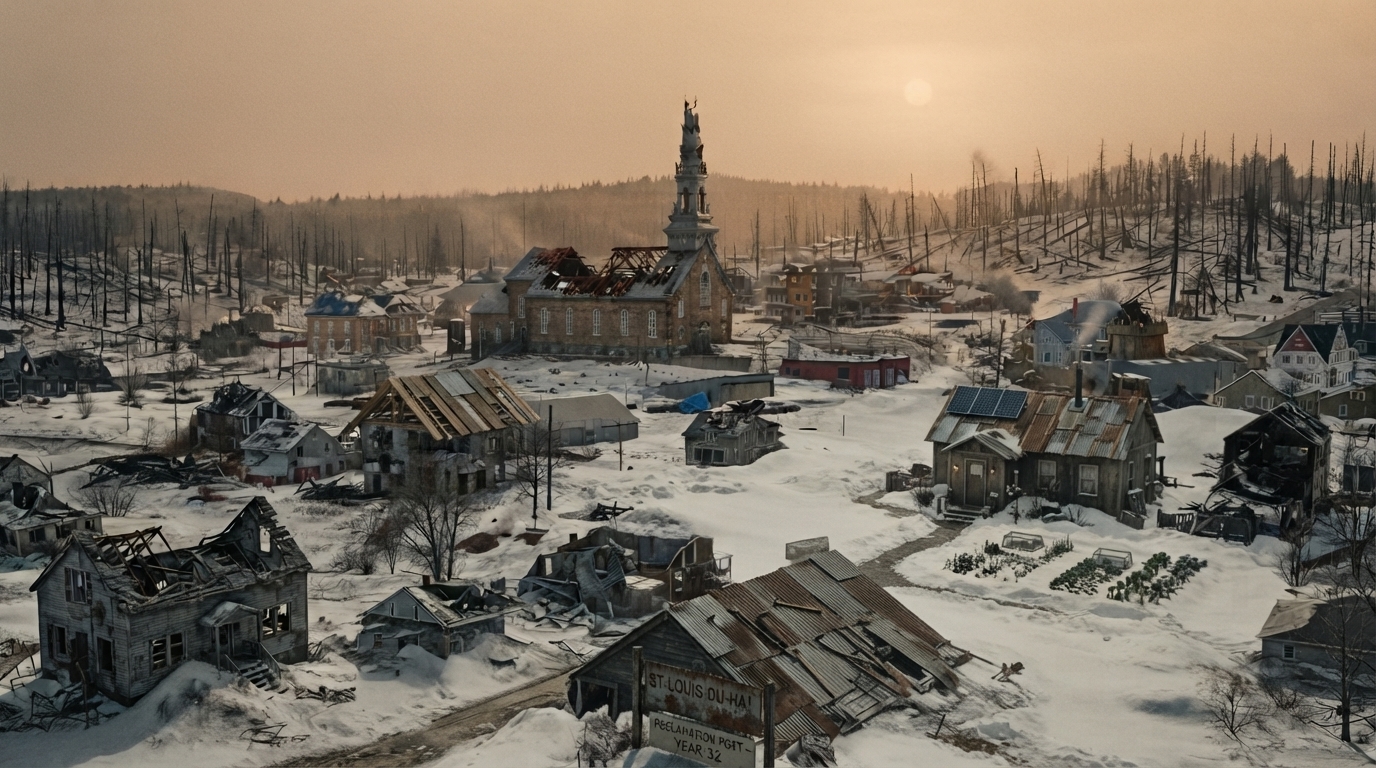
THE LONG-TAILED BEAST
There are places whose names sound as though they were invented for a story. Saint-Louis-du-Ha! Ha! is one of them.
The two exclamation marks are official, and they are part of what makes the Quebec municipality so memorable. Guinness World Records has recognized Saint-Louis-du-Ha! Ha! as the municipality with the most exclamation marks in its name. Yet the name is only the beginning of what makes the place unusual. Saint-Louis-du-Ha! Ha! sits in the Témiscouata region of Bas-Saint-Laurent, on the Appalachian plateau between the Saint Lawrence River and the New Brunswick border, in a landscape shaped by forests, lakes, agriculture and centuries of travel.
It is precisely the kind of place that can become more interesting the longer you look at it.
For Warriors of the Last Days, that makes Saint-Louis-du-Ha! Ha! particularly useful. The setting does not need to be transformed into something spectacular after the Collapse. It already has enough history, geography and folklore to carry a story of its own.
The Témiscouata Region
Saint-Louis-du-Ha! Ha! is part of the MRC de Témiscouata, in Quebec’s Bas-Saint-Laurent region. The municipality lies inland rather than directly on the Saint Lawrence, on elevated terrain surrounded by the wooded hills, agricultural land and waterways characteristic of the Témiscouata plateau.
The municipality covers roughly 114 square kilometres and includes Lac Dole and Lac Savane. The much larger Lake Témiscouata lies nearby, forming one of the defining geographical features of the region. Unlike the Saguenay Fjord, with its enormous cliffs and dramatic scale, Témiscouata is a quieter landscape. Its hills roll rather than rise abruptly, and its forests and lakes tend to reveal themselves gradually.
That quieter geography is useful for fiction. There are plenty of places where a settlement can disappear into the landscape, where a road can run through forest for kilometres before reaching another cluster of buildings, and where the distance between communities becomes significant once modern transportation is no longer reliable.
Saint-Louis-du-Ha! Ha! itself developed during the nineteenth-century period of colonization. The mission was established around 1860, the parish was canonically erected in 1873, and the municipality was created in 1874. Settlement had begun several years earlier, as agricultural communities gradually developed in territory that had already been crossed by travellers for generations.
The history of those earlier travellers is one of the most important things about the region.
The Route Through Témiscouata
Long before highways connected Quebec with New Brunswick, the Témiscouata region provided one of the important overland routes between the Saint Lawrence and the interior.
The historic Grand-Portage connected the Rivière-du-Loup area with Lake Témiscouata and the routes leading toward Madawaska and the Acadian regions. The route was already known in the early colonial period and appears on Samuel de Champlain’s 1612 map. Missionaries, fur traders and other travellers used it, and over time sections of the trail were improved to accommodate carts and later wheeled and winter transportation.
The geography explains why the route mattered. Lake Témiscouata provided an important natural corridor, but its shape and surrounding terrain meant that travellers could not simply follow waterways continuously toward the Saint John River system. At certain points they had to leave the water and carry their equipment overland. The portage became an established transportation route precisely because the landscape forced people to solve the same problem again and again.
That pattern continued into the modern era. The Témiscouata Railway reached the region in 1885, connecting Edmundston with Rivière-du-Loup and giving the corridor a new importance for commercial transportation. Much later, Route 185 became the principal highway connection between Quebec and New Brunswick, and it is now being progressively replaced by Autoroute 85.
The technology has changed repeatedly, but the underlying geography has remained remarkably persistent.
People still need to cross this part of Quebec to move between the Saint Lawrence valley and New Brunswick.
That history gives Saint-Louis-du-Ha! Ha! a particular significance in a post-apocalyptic setting. A modern highway is not simply a convenient line drawn across an otherwise arbitrary landscape. It represents the latest version of a route that people have been using because the geography makes it useful.
After the Light, that same geography would continue to matter.
The highway might be damaged or abandoned, but the corridor would remain. People moving east or west would still have reasons to follow it. A functioning bridge, a passable section of road or a settlement capable of providing food and shelter could become disproportionately important. In a world where long-distance travel has become dangerous and unreliable, the old routes would acquire a new value.
Saint-Louis-du-Ha! Ha! would therefore not need to become an invented fortress or strategic settlement for The Long Tailed Beast. Its significance could grow naturally from something that was already true about the place.
It sits along a route people have always needed.
A Name That Remembers the Landscape
Then there is the name.
Saint-Louis-du-Ha! Ha! is famous because it looks like a joke on a map, but its origins are considerably more interesting. The Commission de toponymie du Québec connects the “Ha! Ha!” to the old French word haha, which could refer to an unexpected obstacle, a dead end or an interruption in a route.
That interpretation has a particularly strong connection to Témiscouata’s geography.
Travellers approaching Lake Témiscouata eventually encountered a point where their journey could not continue in the straightforward way that a traveller following a waterway might expect. The route was interrupted, and an overland portage was necessary. The landscape itself had effectively told the traveller that the easy route was over.
There are other traditions surrounding the name. One popular explanation describes travellers reaching a high point from which Lake Témiscouata suddenly appeared below them, prompting an exclamation of surprise or admiration. Local tradition has preserved that version, while the Commission de toponymie considers the haha explanation more credible and rejects several proposed Indigenous-language origins that have circulated over the years.
Either way, the name is tied to an encounter with the landscape.
That makes it more interesting than a simple curiosity.
The town’s name is, in a sense, a piece of geographical memory. It preserves the experience of travellers discovering that the route ahead was not going to be as simple as they had expected.
For a post-apocalyptic story, there is something almost too appropriate about that.
The Old Stories
The creature at the centre of The Long Tailed Beast does not actually come from Saint-Louis-du-Ha! Ha! It comes from somewhere else.
Honoré Beaugrand included La Bête à Grand’Queue, the Beast with the Big Tail, in his 1900 collection La Chasse-galerie et autres légendes canadiennes. Beaugrand’s story is set in the Berthierville area, in what is now Lanaudière. The legend belongs to an older Quebec tradition in which supernatural creatures, religious beliefs, rural life and the dangers of the countryside were woven together into stories that could be frightening, humorous or both at once.
The creature itself is memorable for its enormous tail, while the story also draws on the Quebec tradition of the loup-garou and on older beliefs surrounding religious obligations and supernatural punishment. Like many folk tales, it occupies an uncertain space between entertainment and warning, with human trickery playing as important a role as the supernatural. Saint-Louis-du-Ha! Ha! has no historical claim on the creature. That is precisely what makes the idea interesting.
For Warriors of the Last Days, the legend is being moved from the Berthierville region to Témiscouata, where it encounters an entirely different landscape. The original story belongs to the agricultural country around the Saint Lawrence. The new story places the creature among the forests, lakes, hills and old transportation corridors of eastern Quebec, beside a municipality whose own name already sounds like something from a folk tale.
The legend is therefore not being presented as something Saint-Louis-du-Ha! Ha! has always told about itself. It is an old Quebec story that has survived long enough to travel. After the Light, perhaps it travels farther.
That creates an interesting question for the story. When the old world disappears and communities become isolated from one another, folklore does not necessarily disappear with it. Stories can travel with people. A survivor from the Berthierville region might know Beaugrand’s tale. Someone in Témiscouata might hear it years later. Another person might remember only the creature’s name. Eventually, the story could become attached to a new place. By then, nobody may remember where it originally came from.
The people of Saint-Louis-du-Ha! Ha! would have their own landscape, their own history and their own reasons to believe that the woods contain things that should not be there. The old Beast would arrive carrying a story from another part of Quebec, and the post-nuclear world would provide an entirely new context in which to interpret it.
That is the fictional connection. The folklore is real. The relocation is ours.
The Long Tailed Beast
The Saint-Louis-du-Ha! Ha! story is currently in concept stage under the title The Long Tailed Beast.
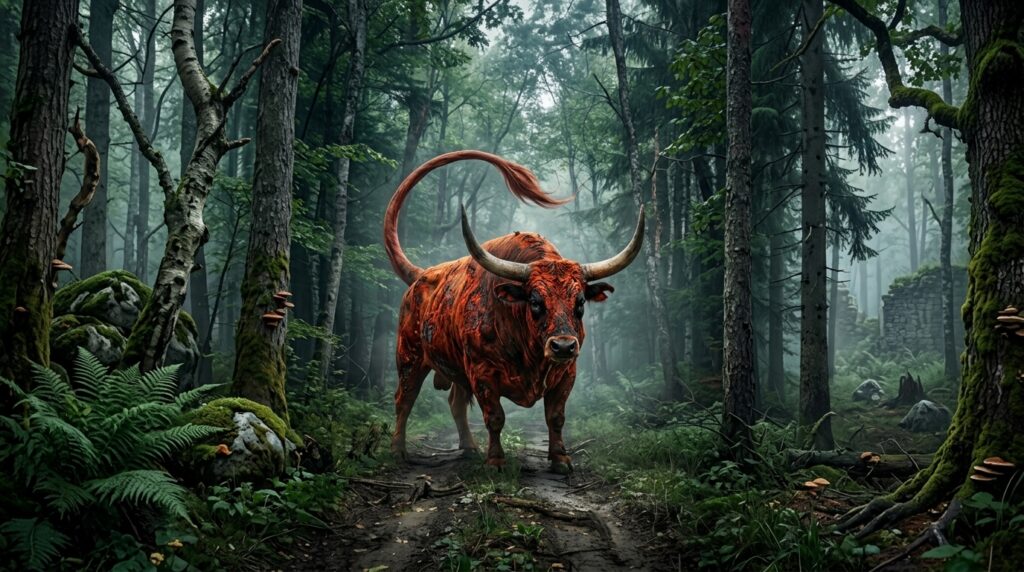
The location provides the story with several layers that all belong to the real place. There is the agricultural community that developed during the nineteenth century, the forests and lakes surrounding it, and the transportation corridor that has connected the Saint Lawrence with New Brunswick for centuries. There is the modern highway, built on top of a much older pattern of movement, and there is the strange municipal name that preserves the memory of travellers discovering an unexpected obstacle in their path.
Then there is La Bête à Grand’Queue.
The idea is not to take a generic post-apocalyptic monster and drop it into Saint-Louis-du-Ha! Ha! simply because the name sounds appropriate. The story begins with things that are already there: the geography, the roads, the forests, the local history and a piece of Quebec folklore that predates the twentieth century.
The Collapse changes the circumstances surrounding those things. It does not have to invent them. That distinction matters to Warriors of the Last Days. The stories are built around real Canadian places whose particular characteristics can become part of the fiction. Saint-Louis-du-Ha! Ha! offers an unusually rich example because almost everything about it seems to invite a story. The name is memorable, the landscape has a history of forcing travellers to change direction, and an old Quebec legend provides a creature that can cross the boundary between folklore and the altered natural world.
The research can tell us that the town exists, where it sits, how its transportation routes developed and where its unusual name came from. It can tell us about the lakes, the forests, the farms and the old portage routes that shaped the region. It cannot tell us whether something with an enormous tail is moving through the woods after the Light.
That part belongs to The Long Tailed Beast.
A new post-apocalyptic story from Canada. Every month.
The earlier you join, the larger your library becomes.
Join now. Start building your library before the next hundred.
 Stéphane Roy is a lifelong reader and writer with a deep love for science fiction, apocalyptic worlds, and tightly constructed mysteries. This is his first novel. He lives in the Yukon with his dog and his aquarium, where long winters, silence, and wide, sometimes glowing, skies leave plenty of room for imagining the end of the world, and what might come after it. He is also waiting, with cautious optimism, for the aliens to finally reveal themselves and straighten us all out.