

EXPLORE THE HAIDA GWAII ISLANDS
Haida Gwaii is an archipelago of more than 150 islands off the northern coast of British Columbia, separated from the mainland by Hecate Strait. The name means “Islands of the People” in Haida. For much of the colonial period, the islands were known as the Queen Charlotte Islands, a name that has largely given way to the name used by the Haida themselves.
The islands are a place of old forests, exposed coastline, deep inlets, constant rain and some of the richest marine life on the Pacific coast. They are also a place where human history reaches back thousands of years. The Haida have lived here for at least 13,000 years, developing a culture inseparable from the islands, the sea and the forests.
That combination makes Haida Gwaii unusually powerful as a setting for speculative fiction. The landscape does not feel empty or recently abandoned. It feels occupied, layered and extremely old. The forest is not scenery. The ocean is not a backdrop. Everything seems to belong to a system that existed long before anyone drew the modern map.
Geography & Environment
Haida Gwaii lies on the continental shelf west of British Columbia, with Hecate Strait separating the islands from the mainland. Graham Island is the larger and more populated of the two principal islands, while Moresby Island and the islands surrounding it form a much wilder southern region.
The climate is maritime and wet, with enormous quantities of rain supporting temperate rainforest. Western red cedar, Sitka spruce, western hemlock and other species dominate the landscape, with trees reaching sizes that make the forest feel less like a collection of individual organisms than a continuous living structure.
The relationship between land and sea is equally important. Salmon, herring and eulachon support an ecosystem that extends from the forest into the coastal waters. Humpback whales and orcas move through the surrounding seas, while seabirds occupy the offshore rocks and islands.
The result is a landscape that is difficult to separate into wilderness and civilization. The forest provides food, materials and shelter. The sea connects the islands to one another and to the mainland. The weather can isolate communities for days. Distances that look insignificant on a map become meaningful when the only route between them is through rough water.
For a post-apocalyptic story, that creates a very different kind of environment from the conventional wasteland. There is no need to imagine nature returning after civilization disappears. Nature never left.
Haida Gwaii and the Haida
Haida Gwaii is not an abandoned wilderness waiting to be discovered. It is the homeland of the Haida, whose communities, language, art, traditions and history remain part of the islands today.
Haida culture includes one of the great artistic traditions of the Northwest Coast, with monumental cedar carving, weaving, design and oral histories carrying knowledge across generations. Raven occupies an important place in Haida stories, including stories of transformation and the bringing of light into the world.
Those traditions are part of what gives the landscape its particular depth for a story about things that exist beyond ordinary human understanding. But the important distinction is that the mythology does not need to be turned into horror to make Haida Gwaii strange. The place is already layered with its own history and meaning.
That is particularly evident in the relationship between people and cedar. Cedar is material, shelter, transportation, art and history. A carved piece of wood can carry the work of an individual artist while remaining part of a much older relationship between the Haida and the forest.
That relationship is at the centre of the Warriors of the Last Days story set here.
Tow Hill
Tow Hill rises on the northeastern coast of Graham Island, near Old Massett. The trail from the community leads through forest toward the distinctive volcanic formation overlooking the Pacific.
In Warriors of the Last Days, Tow Hill becomes the place where a Haida carver named James witnesses the Light, the event that begins the Collapse.
He does not see it from some invented wilderness. He sees it from a real landscape, surrounded by the cedar forest that makes Haida Gwaii what it is.
The story’s central image begins with something much more intimate. Cedar in James’s shed starts to develop a shape of its own, mapping a face into the wood as he works. The phenomenon forces him to confront something beyond his understanding while remaining rooted in the things he does understand: carving, cedar, family and the land around him.
The story’s supernatural element is therefore not imposed on Haida Gwaii from somewhere else. It grows directly out of the relationship between the carver and the forest.
And that is where the setting becomes important. James is not simply standing in a rainforest when something strange happens. He is working with a material that has carried generations of knowledge, in a landscape where the boundary between the living world and the stories told about it has never been particularly simple.
The Naden Carcass
Haida Gwaii also has its own piece of twentieth-century strangeness.
In 1937, a sperm whale was killed near Naden Harbour. Inside its stomach was a large unidentified object that witnesses described as reptilian and roughly ten feet long, with a head compared to that of a horse or camel.
The remains were eventually taken to Victoria, where the museum director identified them as whale material and discarded them. Photographs of the supposed creature survive, although they do not establish what the object actually was.
The Naden Carcass belongs to a very different category from Haida mythology and should not be confused with it. It is a historical mystery, surrounded by incomplete evidence and decades of speculation.
That distinction is precisely what makes it useful.
Haida Gwaii does not need a fictional monster to have a strange story attached to it. There is already an old photograph, a dead whale, an unexplained object and a museum decision that left very little physical evidence behind.
The question remains open because the evidence is gone.
Haida Gwaii in Warriors of the Last Days
The Haida Gwaii story explores one of the recurring ideas in Warriors of the Last Days: the possibility that intelligence can exist in forms humans are poorly equipped to recognize.
James encounters that intelligence through the cedar he is carving. The phenomenon develops into something connected to the larger mycelial network that appears elsewhere in the series, an underground biological intelligence whose presence becomes increasingly difficult to dismiss as isolated events.
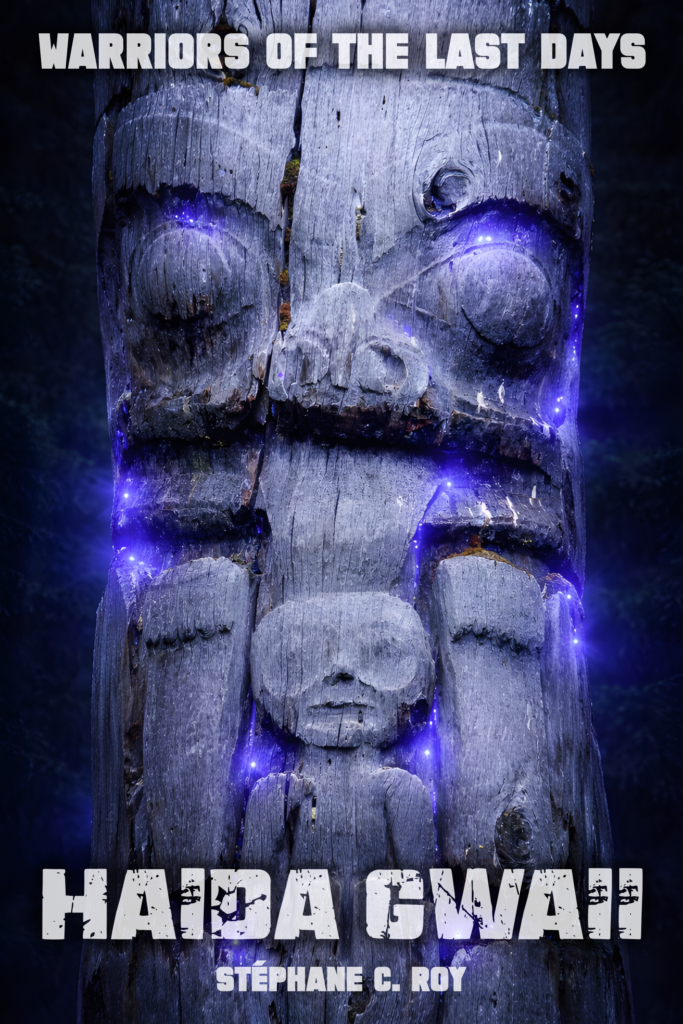
The setting allows that idea to develop differently from the stories elsewhere in the series. Here, the forest itself becomes part of the mystery.
The cedar carries the signal. James receives something he cannot fully understand. Offshore, the Northern Resident orcas begin behaving in ways that draw his attention. Their presence becomes increasingly difficult to regard as coincidence.
The story does not need to explain every element. In fact, the unexplained parts are important. The forest, the animals and the human observer are placed together, and the reader is left to consider whether they are witnessing separate phenomena or different expressions of the same thing.
That uncertainty is where Haida Gwaii becomes more than a backdrop.
A Place That Was Already Old
There is a temptation in post-apocalyptic fiction to imagine that the apocalypse is what makes a place strange.
Haida Gwaii works differently.
The islands were ancient before the Collapse. The forests were already immense. The sea already carried animals across Hecate Strait. Cedar already connected the practical world with art, history and tradition. People had already lived on these islands for thousands of years.
The Collapse simply changes what can be seen.
In the Haida Gwaii story, the strange thing begins with cedar in a carver’s shed. It spreads into the forest and eventually reaches the sea. James is caught between what he knows, what his traditions have taught him to recognize and something that does not fit comfortably into either category.
That makes Haida Gwaii one of the most compelling settings in the Warriors of the Last Days universe.
The story does not need to make the islands strange.
They already are.
A new post-apocalyptic story from Canada. Every month.
The earlier you join, the larger your library becomes.
Join now. Start building your library before the next hundred.
 Stéphane Roy is a lifelong reader and writer with a deep love for science fiction, apocalyptic worlds, and tightly constructed mysteries. This is his first novel. He lives in the Yukon with his dog and his aquarium, where long winters, silence, and wide, sometimes glowing, skies leave plenty of room for imagining the end of the world, and what might come after it. He is also waiting, with cautious optimism, for the aliens to finally reveal themselves and straighten us all out.