
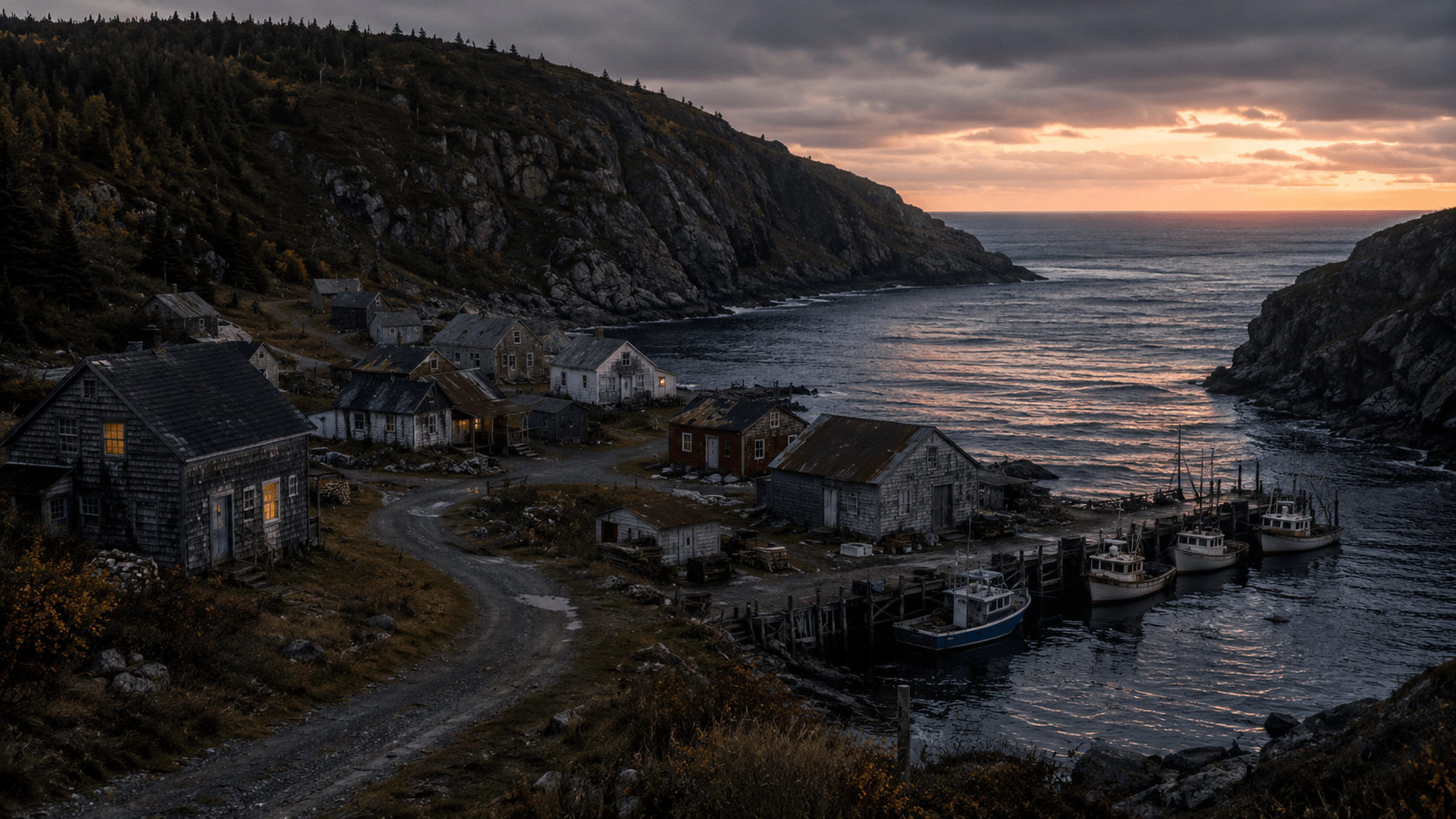
MEAT COVE. NOVA SCOTIA.
There are places in Canada whose names seem to have been waiting for a horror story.
Meat Cove is one of them.
At the northernmost tip of Cape Breton Island, Nova Scotia, the road eventually gives up. You leave the Cabot Trail near Cape North, follow the road toward Bay St. Lawrence, and then turn onto Meat Cove Road. The final eight kilometres are unpaved. Beyond them is a small coastal community surrounded by steep hills, cliffs, forest and the Gulf of St. Lawrence.
Tourism Nova Scotia describes Meat Cove as the most northerly point in Nova Scotia. The Canadian Geographical Names Database lists the community at approximately 47.024° N, 60.560° W, and the cove itself a little farther east. The place is officially called Meat Cove. There is no fictional alteration hiding behind the name.
The road really does end there. That mattered when we were writing the short story “Meat Cove,” which will be released this Halloween.
A name with an actual history
The obvious question is why anyone would call a beautiful coastal settlement Meat Cove.
The answer is less mysterious than the name suggests, although the historical record leaves room for some variation.
An old historical account of Nova Scotia place names says Meat Cove received its name because of the large numbers of moose and caribou found there in earlier times, providing meat for Indigenous people and others who travelled through the area. Local accounts have also connected the name with hunting by people arriving along the coast and with the processing of game in the cove.
Another local explanation holds that ships could stop in the sheltered cove, hunt game in the surrounding highlands, and replenish their supplies. The story has also been told in connection with the smell of cooking meat carrying out toward vessels offshore.
The important part is that the name is not modern marketing. Meat Cove is an official geographical name, and the explanation involving abundant game has been recorded for generations. The real place was associated with meat long before we wrote a story about it. That was too good to ignore.
The landscape does most of the work
Meat Cove sits at the extreme northern end of Cape Breton, where the land becomes increasingly rugged and the communities increasingly sparse.
You don’t simply arrive at Meat Cove by driving through an ordinary rural settlement. From Cape North, the route travels through the northern Cape Breton landscape before the final turn onto Meat Cove Road. The last eight kilometres are unpaved, and the community sits beyond them at the edge of the coast.
The surrounding country is dominated by the Cape Breton Highlands. Jagged cliffs rise around the community, with steep valleys and forest running down toward the water. From the coast, there are views across the Gulf of St. Lawrence and toward the Northumberland Strait. Bald eagles are common enough in the region to be part of the landscape, and whales can sometimes be seen offshore during the warmer months. It is easy to understand why the place feels isolated.
It isn’t merely far from a major city. The geography itself creates the isolation. Mountains restrict the approaches. The ocean closes one side. The road comes in from the south and eventually stops. For a post-apocalyptic story, that is almost cheating.
A real fishing community
Despite the spectacular scenery, Meat Cove was not created as a tourist attraction. It has long been a fishing community.
Historical accounts describe the people of Meat Cove as fishermen working in an environment where agriculture was difficult and fishing was central to the local economy. A 19th-century federal fisheries report also records fishing activity at Meat Cove, including mackerel catches in the area in 1894. That history matters because the community’s relationship with the water is practical rather than picturesque. The cove is shelter, workplace, route and food source.
The modern community still reflects that connection. Meat Cove today has only a small population, with tourism providing another reason for people to make the journey. The campground sits dramatically above the coast and offers campsites, wilderness cabins, hiking access and views over the surrounding landscape. But the essential geography hasn’t changed.
There is still a small community at the end of the road, surrounded by an enormous landscape.
The end of the road
That phrase kept coming back while we were working on the story.
The end of the road.
It has a literal meaning in Meat Cove. Tourism Nova Scotia describes the community as approximately 30 kilometres from Cape North, with the final eight kilometres of the route unpaved. Historically, that isolation could have serious consequences.
In 1926, for example, a winter shortage reportedly drove several Meat Cove men to make a dangerous journey across the ice to Pleasant Bay to obtain flour and oats for the community. The trip covered roughly 65 kilometres each way. That detail tells us something more interesting about Meat Cove than its spectacular views do. People stayed there because it was home. They fished there. They hunted there. They endured winters there. They maintained a community in a place where simply reaching the outside world could become an undertaking. The isolation was not a tourist experience. It was life.
Which is where our story begins
In “Meat Cove,” a man drives north after the Collapse. He doesn’t have a plan. He doesn’t have a destination. He simply keeps going until the geography makes the decision for him.
He reaches the end of the Cabot Trail region, takes the road toward Meat Cove, and drives the final eight kilometres as the light disappears.
Then he finds a village. There is food. There is shelter. There are people who know how to survive. And there is the name.
Meat Cove.
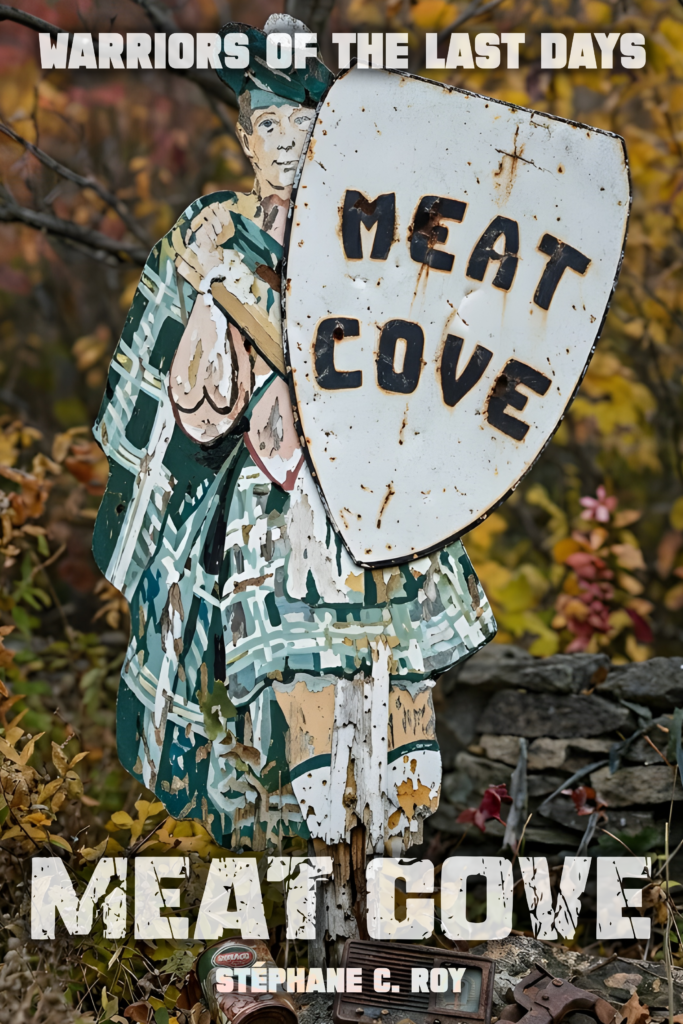
The story takes the real history of the place and turns it sideways. The fishing is still good. The community is still isolated. The food is still important. The ocean is still outside every window. But something else has been living beneath the cove for a very long time. We won’t tell you what it is here. Part of the fun of the story is discovering why a man who has spent his entire life paying attention can still miss the most obvious clue in front of him. Because the real Meat Cove already gives us the perfect opening.
The road ends. The mountains close in. The Atlantic stretches out beyond the cliffs. And the name has been sitting there for generations, waiting for someone to take it literally.
This Halloween, we’re going to find out what happens when someone does.
A new post-apocalyptic story from Canada. Every month.
The earlier you join, the larger your library becomes.
Join now. Start building your library before the next hundred.
 Stéphane Roy is a lifelong reader and writer with a deep love for science fiction, apocalyptic worlds, and tightly constructed mysteries. This is his first novel. He lives in the Yukon with his dog and his aquarium, where long winters, silence, and wide, sometimes glowing, skies leave plenty of room for imagining the end of the world, and what might come after it. He is also waiting, with cautious optimism, for the aliens to finally reveal themselves and straighten us all out.