
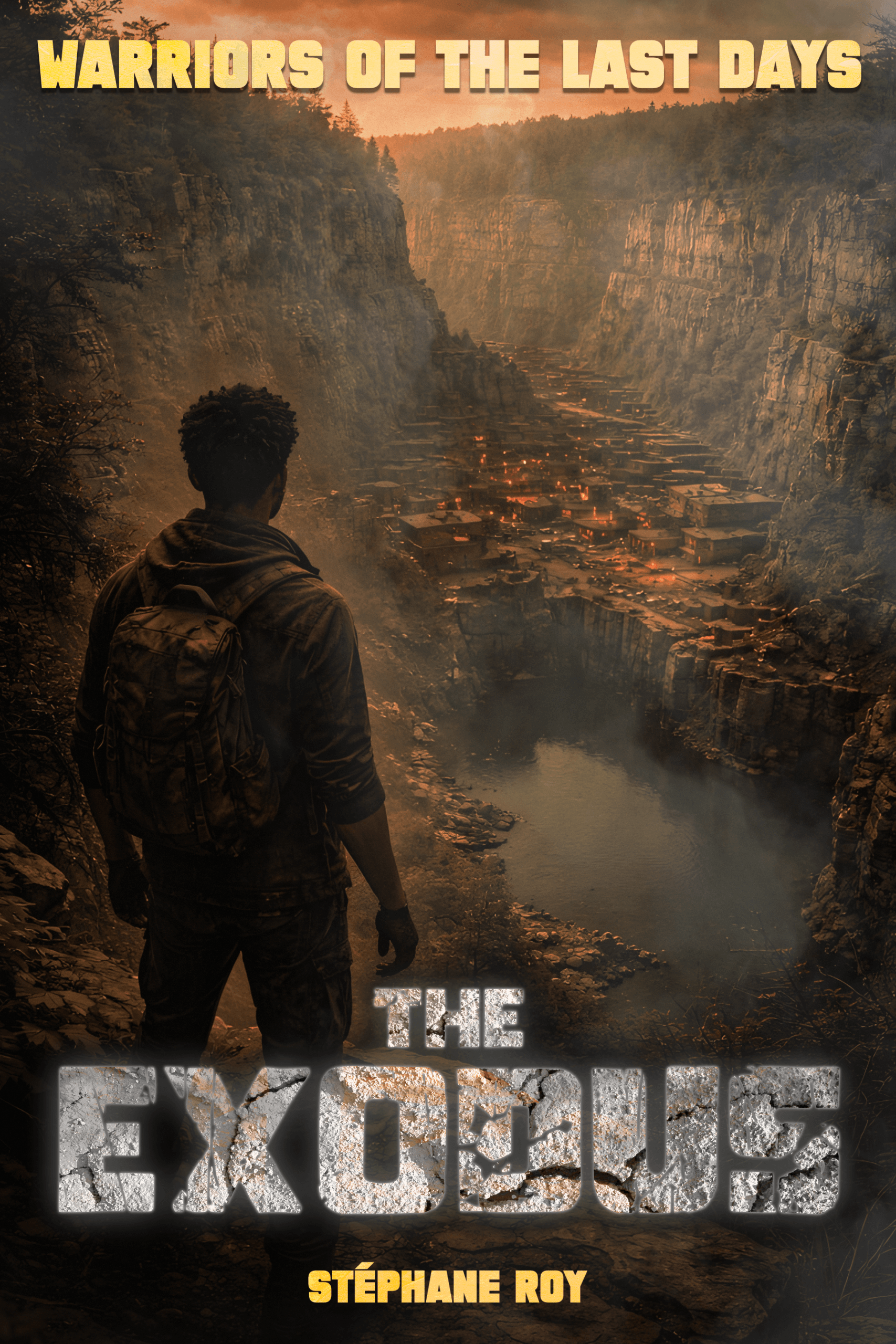
DYSTOPIAN TROPES OF BOOK II: THE EXODUS
CORE STRUCTURAL TROPES
The Exodus Without a Promised Land
Movement is necessary, not hopeful.
There is no destination that improves moral conditions—only zones of different failure.
Subversion: Exodus is loss-minimization, not deliverance.
Flight Escalates the Threat
Leaving safety increases system attention rather than reducing it.
Motion generates trace, noise, prediction vectors.
Escape is an accelerant.
The Point of No Return
Crossing thresholds (physical and procedural) irreversibly alters status.
Credentials, access, and protection decay silently after passage.
No dramatic alarm—just disappearance from legitimacy.
The Narrow Path
Survival corridors are constrained by infrastructure, timing, and policy.
Freedom exists only inside thin operational windows.
Choice is replaced by sequencing.
CHARACTER / RELATIONSHIPS TROPES
The Reluctant Co-Conspirator
Bishop’s alignment shifts from handler to liability.
His decision is not ideological—it is forced by consequence.
Subversion: loyalty collapses before belief does.
The Burdened Witness
Una does not lead the escape; she endures it.
Her role is observational pressure rather than command.
Knowledge accumulates faster than agency.
The Fracturing Ally
Companions do not unify under stress.
Injury, exhaustion, and fear isolate rather than bond.
Survival becomes asymmetric.
The Authority That Lets You Go
The system does not immediately pursue.
Observation continues; intervention is delayed.
Subversion: escape is permitted because it is informative.
WORLD / SYSTEM TROPES
Infrastructure as Funnel
Tunnels, corridors, vents, and transit paths dictate behavior.
Geography enforces compliance long after authority is gone.
Permission Decay
Access degrades over time rather than switching off.
Systems fail “politely,” creating ambiguity and false hope.
Invisible Borders
No walls, guards, or gates—only changing rule-sets.
Crossing zones alters what actions are legal, tolerated, or fatal.
Environmental Hostility Without Malice
Heat, pressure, water, and confinement are indifferent forces.
Nature does not oppose escape; it simply does not care.
THEMATIC / PHILOSOPHICAL TROPES
Escape as Exposure
Leaving reveals how dependent survival was on structure.
Autonomy increases vulnerability.
Care Turns Lethal
Medical aid, rest, and caution become risks under motion.
What preserved life inside now threatens it outside.
The Body as the Failing System
Injury, infection, exhaustion replace ideology as antagonists.
The human body cannot be optimized indefinitely.
Hope as Miscalculation
Hope introduces timing errors and overextension.
Optimism is a liability in constrained environments.
GENRE-SPECIFIC SUBVERSIONS
No Rallying Escape
There is no cathartic breakout moment.
Escape is fragmented, quiet, and physically miserable.
No Clean Separation From the System
Surveillance and consequence extend beyond borders.
The system’s logic still applies, even when unseen.
Motion Does Not Equal Agency
Characters move constantly but decide very little.
Direction replaces choice.
SUMMARY
THE EXODUS reframes the escape narrative as a study in exposure: leaving the system does not free the characters from its logic: it strips away the protections that made survival possible.
FREQUENTLY ASKED QUESTIONS
What is a trope?
A recurring pattern, character type, or structural device that appears across many stories in a genre. Tropes are not flaws, they are the shared vocabulary of storytelling. What matters is what a writer does with them.
What is a subversion?
When a story uses a familiar trope but deliberately breaks the expectation attached to it. Not to be clever, but because the story’s logic demands it.
Is this series for me?
If you read dystopia for world architecture, systemic logic, and character behavior under pressure, yes. If you need a protagonist who figures it out and wins, probably not, or at least not in the way you’re expecting.
Why list tropes at all — doesn’t that spoil the book?
Knowing a story uses “the system is the villain” doesn’t tell you what happens any more than knowing a film is a tragedy tells you who dies. Tropes describe structure, not plot.
How is this different from other dystopian series?
Most dystopia is about resistance. This series is about what happens before resistance becomes possible and whether it ever does.
© Copyright 2026 WARRIORS OF THE LAST DAYS All rights reserved Privacy Policy
 Stéphane Roy is a lifelong reader and writer with a deep love for science fiction, apocalyptic worlds, and tightly constructed mysteries. This is his first novel. He lives in the Yukon with his dog and his aquarium, where long winters, silence, and wide, sometimes glowing, skies leave plenty of room for imagining the end of the world, and what might come after it. He is also waiting, with cautious optimism, for the aliens to finally reveal themselves and straighten us all out.