
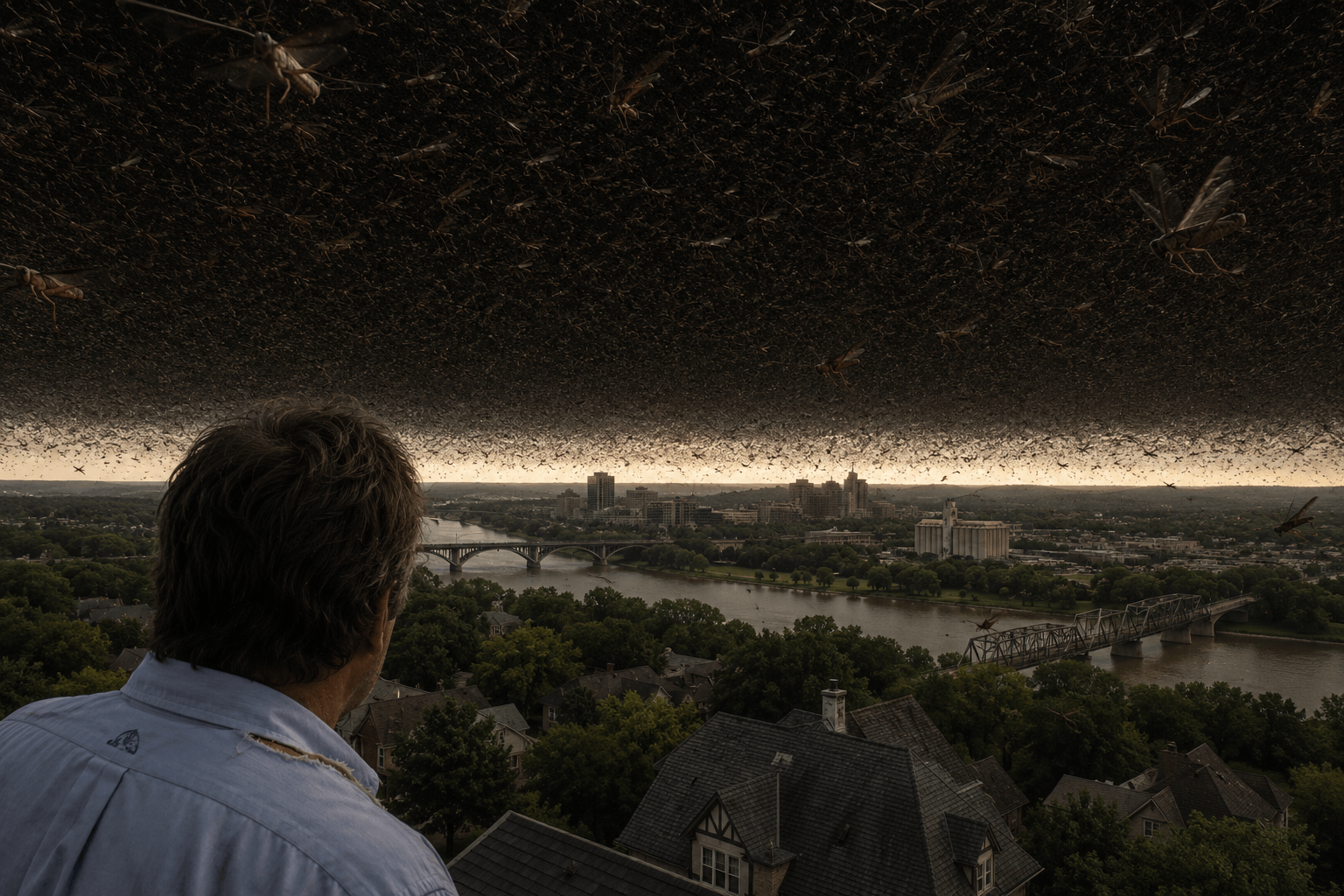
Post-Apocalypse Stories in Saskatchewan:
Why the Canadian Prairies Are Perfect for the End of the World
When readers think of post-apocalyptic fiction, they often imagine the blasted deserts of the American Southwest, ruined megacities, or frozen wastelands somewhere in the far North. Saskatchewan rarely appears on those lists.
It should.
THE CASE FOR POST-APOCALYPSE FICTION IN SASKATCHEWAN:
The Canadian prairie province possesses nearly every ingredient required for compelling end-of-the-world storytelling: enormous distances, harsh weather, agricultural dependence, sparse population, fragile infrastructure, and a landscape so open that danger can sometimes be seen hours before it arrives.
Saskatchewan is a place where geography matters. If civilization collapses, geography becomes destiny.
While Saskatchewan has not produced as many post-apocalyptic novels as larger literary markets, it has nonetheless appeared repeatedly in dystopian and speculative fiction. Authors continue returning to the province because the prairie itself naturally generates tension. Isolation, exposure, scarcity, migration, and survival are not hypothetical concepts here. They are embedded in the history and culture of the region.
For writers and readers of post-apocalyptic fiction, Saskatchewan offers something unique: apocalypse without spectacle.
There are no mountain ranges to hide behind. No oceans to escape across. No dense forests to disappear into. Only sky, grass, weather, and whatever is coming across the horizon.
Why Saskatchewan Works So Well as a Post-Apocalyptic Setting
The prairies possess characteristics rarely found together elsewhere.
1. Isolation
Saskatchewan is vast.
The province covers more than 650,000 square kilometres while maintaining a relatively small population concentrated primarily around major centres such as Saskatoon, Regina, Prince Albert, Moose Jaw, and a scattering of smaller communities.
In a societal collapse, this creates immediate challenges:
- Supply chains disappear.
- Medical services become inaccessible.
- Fuel shortages become catastrophic.
- Communication networks fail.
- Communities become isolated islands.
A survivor living on a farm fifty kilometres from the nearest town might effectively be alone.
Unlike urban apocalypse fiction, where survivors constantly encounter other groups, Saskatchewan allows authors to explore prolonged isolation and psychological deterioration.
Silence itself becomes an antagonist.
2. Extreme Weather
Weather has always shaped life on the prairies.
Saskatchewan routinely experiences:
- Blizzards.
- Extreme cold below -40°C.
- Heat waves exceeding 35°C.
- Severe thunderstorms.
- Tornadoes.
- Drought.
- Dust storms.
In a post-collapse world, these conditions become deadly.
Without:
- electricity,
- natural gas,
- snow clearing,
- emergency response,
- modern agriculture,
the climate alone could destroy entire communities.
The environment does not merely provide atmosphere. It actively participates in survival.
3. The Open Horizon
The prairie horizon is one of Saskatchewan’s defining features.
You can often see weather systems approaching from extraordinary distances.
This openness creates a distinctive form of horror.
In forests, danger hides. On the prairie, danger announces itself.
You watch it coming. And sometimes there is nowhere to go.
Few landscapes generate dread as effectively as seeing a storm, wildfire, military convoy, infected horde, or unknown phenomenon stretching across the entire northern horizon.
4. Agriculture and Collapse
Saskatchewan is one of the world’s great agricultural regions.
The province produces enormous quantities of:
- wheat,
- canola,
- lentils,
- oats,
- barley,
- peas.
Modern civilization depends heavily upon industrial agriculture.
Post-apocalyptic fiction set in Saskatchewan naturally raises questions:
- Who controls food production?
- What happens when fuel disappears?
- Can industrial farming survive without modern machinery?
- Who inherits the grain elevators?
- What happens when crops fail?
Food becomes power. Prairie fiction understands this instinctively.
Existing Post-Apocalyptic and Dystopian Fiction Connected to Saskatchewan
Although relatively uncommon, several notable works either take place in Saskatchewan, pass through it, or draw heavily upon prairie themes.
The Marrow Thieves by Cherie Dimaline
The Marrow Thieves is among the most important Canadian dystopian novels of the twenty-first century.
Set in a climate-ravaged future Canada, the novel follows Indigenous survivors fleeing government “Recruiters” who harvest Indigenous bone marrow because it retains humanity’s lost ability to dream. The story moves across devastated Canadian landscapes, including prairie regions that become spaces of vulnerability and exposure.
The prairie sections are particularly effective because they exploit Saskatchewan’s openness.
There is nowhere to hide. Every crossing becomes dangerous. Every horizon may conceal pursuers.
Dimaline transforms familiar Canadian landscapes into spaces of tension and resistance while grounding the apocalypse within Indigenous experiences and histories.
Corvus by Harold Johnson
Corvus may be one of the clearest examples of Saskatchewan dystopian fiction.
Set in a distant future centred around La Ronge in northern Saskatchewan, the novel explores a post-global-warming society marked by technological stratification, social inequality, and cultural fragmentation. Mass migrations and environmental devastation have transformed northern Saskatchewan into a major population centre.
Harold Johnson’s work demonstrates that Saskatchewan is not merely suitable for apocalypse; it can also sustain fully realized speculative civilizations.
The Long Night: A Zombie Post Apocalypse on the Canadian Prairie by Marshall Brothers
A more recent example is The Long Night: A Zombie Post Apocalypse On The Canadian Prairie.
Published in 2025, the novel embraces many classic post-apocalyptic conventions—ruined communities, moral collapse, wandering survivors, and undead threats—while grounding the story firmly within prairie geography. Readers have specifically highlighted the Saskatchewan setting as one of the book’s distinguishing features.
The novel illustrates growing interest in prairie-specific apocalypse fiction.
A Canticle for Leibowitz and Saskatchewan Connections
No discussion of post-apocalyptic literature would be complete without mentioning the genre-defining classic A Canticle for Leibowitz.
Although the novel itself is not set in Saskatchewan, Walter M. Miller Jr. spent time in the province during the mid-twentieth century while developing portions of the work. The novel’s themes—civilization rebuilding amid vast empty spaces, preservation of knowledge, and cultural memory surviving through isolation—resonate strongly with prairie landscapes.
Many Saskatchewan readers recognize something familiar in Miller’s vision: small communities preserving fragments of civilization against overwhelming historical forces.
Other Canadian Dystopian Works Worth Exploring
Canadian speculative fiction increasingly embraces regional settings.
Examples include:
- The Marigold, a dystopian horror novel set in a collapsing future Toronto where a mysterious organism invades urban life.
- Quantum Night, which incorporates Saskatoon and the Canadian Light Source into a near-future speculative narrative.
Together, these works demonstrate that Canadian apocalypse fiction is becoming increasingly local rather than imitating American settings.
Saskatchewan’s Untapped Apocalyptic Potential
Surprisingly, many Saskatchewan locations remain almost completely unexplored in speculative fiction.
These include:
Saskatoon
The province’s largest city possesses numerous features ideal for post-apocalyptic storytelling:
- The South Saskatchewan River.
- The river bluffs.
- Historic neighbourhoods like Nutana.
- Industrial corridors.
- University infrastructure.
- Rail yards.
- Bridges acting as strategic chokepoints.
The city’s geography naturally divides survivors into competing enclaves. Control the bridges and you control movement.
Regina
As Saskatchewan’s capital, Regina offers:
- government facilities,
- military infrastructure,
- vast suburban zones,
- open approaches from every direction.
A collapsing provincial capital creates opportunities for political and societal narratives.
Northern Saskatchewan
Northern Saskatchewan remains one of Canada’s least populated regions.
Dense boreal forest, thousands of lakes, mining operations, and remote Indigenous communities create ideal settings for:
- survival fiction,
- eco-horror,
- isolation narratives,
- first-contact scenarios.
Potash Mines
Saskatchewan contains some of the world’s largest potash reserves. The immense underground infrastructure associated with mining remains largely untouched by speculative fiction.
Underground caverns kilometres beneath the prairie provide fertile ground for horror, biological mutation, and hidden civilizations.
Saskatchewan Horror Beyond Zombies
Much post-apocalyptic fiction relies on zombies. Saskatchewan deserves broader threats.
Potential prairie-specific catastrophes include:
Ecological Collapse
Drought, topsoil loss, invasive species, and agricultural failure could devastate the province. The Dust Bowl already demonstrated that prairie ecosystems are fragile. Future climate catastrophes could create entirely new forms of apocalypse.
Biological Horror
Agricultural monocultures create opportunities for:
- mutated crops,
- invasive insects,
- fungal outbreaks,
- parasitic organisms.
Prairie agriculture exists on enormous scales.
Any biological threat would also operate on enormous scales.
Weather Apocalypse
Imagine:
- permanent hyperstorms,
- endless blizzards,
- continent-spanning dust events,
- atmospheric anomalies.
Weather already dominates prairie life.
Escalating it only slightly creates catastrophe.
Resource Wars
Water, fertilizer, fuel, and farmland could easily become sources of conflict.
Saskatchewan’s agricultural importance means survivors elsewhere might eventually come seeking food.
Saskatchewan’s Emerging Post-Apocalyptic Voices
Independent and regional authors are increasingly placing Saskatchewan at the centre rather than the margins of speculative fiction.
Among these emerging works are two interconnected short stories—The Legacy and The Stillness—alongside the forthcoming novel The Front.
Together, these stories present a distinctly Saskatchewan apocalypse.
WARRIORS OF THE LAST DAYS POST-APOCALYPSE STORIES IN SASKATCHEWAN:
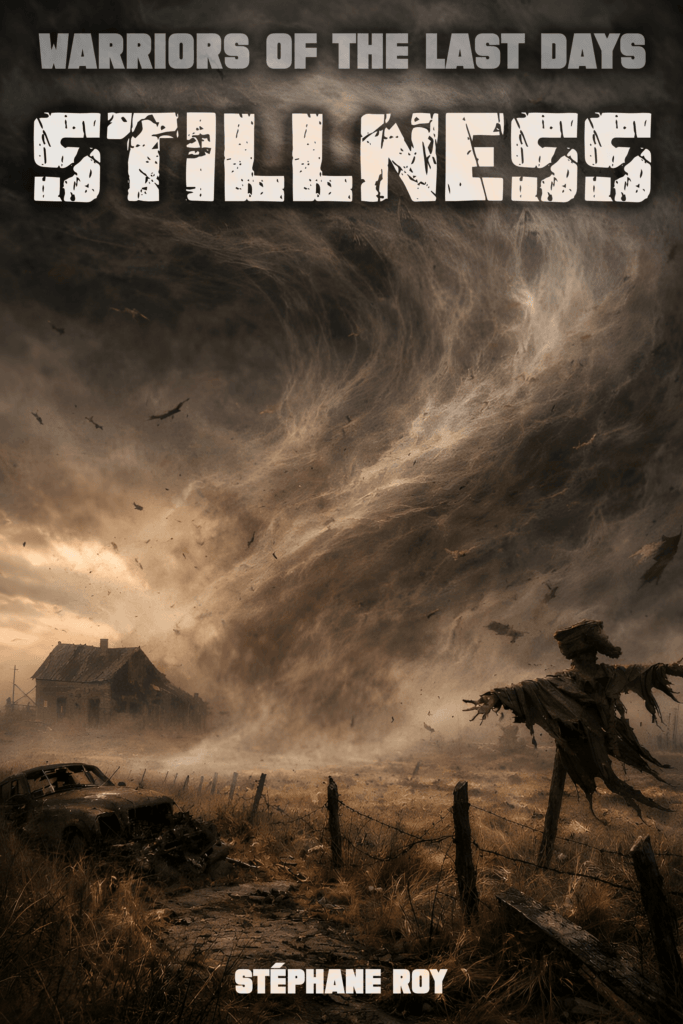
The Stillness
Set on an isolated prairie farm, The Stillness captures something profoundly Saskatchewan: the intimate relationship between prairie people and the wind.
When the decades-long gales suddenly cease at exactly 11:14 AM, veteran farmer Chris immediately understands that something is wrong.
What follows is pure prairie horror. The silence itself becomes terrifying. The northern horizon darkens.
And the open landscape offers no protection.
The Legacy
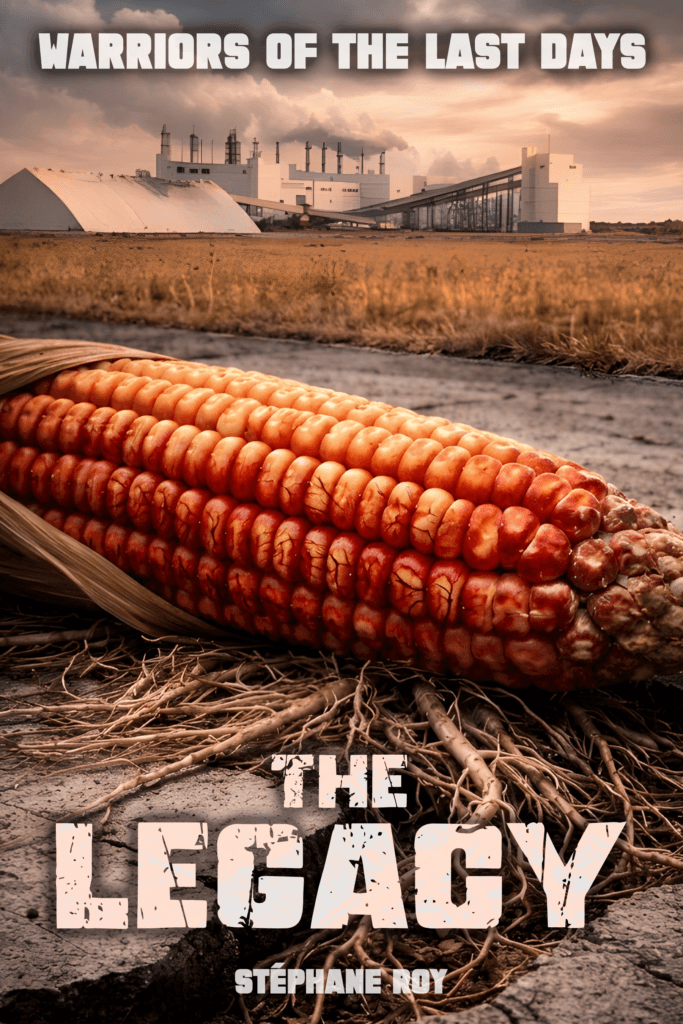
The Legacy shifts underground, into Saskatchewan’s vast potash mining infrastructure.
A seemingly ordinary industrial facility becomes host to an evolving corn-based organism that has spent decades adapting, feeding, and learning beneath the province.
The story combines:
- body horror,
- biological evolution,
- agricultural anxiety,
- industrial archaeology.
It transforms Saskatchewan’s mining economy into existential horror.
The Front (Coming 2027)
The upcoming novel The Front pushes Saskatchewan apocalypse fiction into new territory.
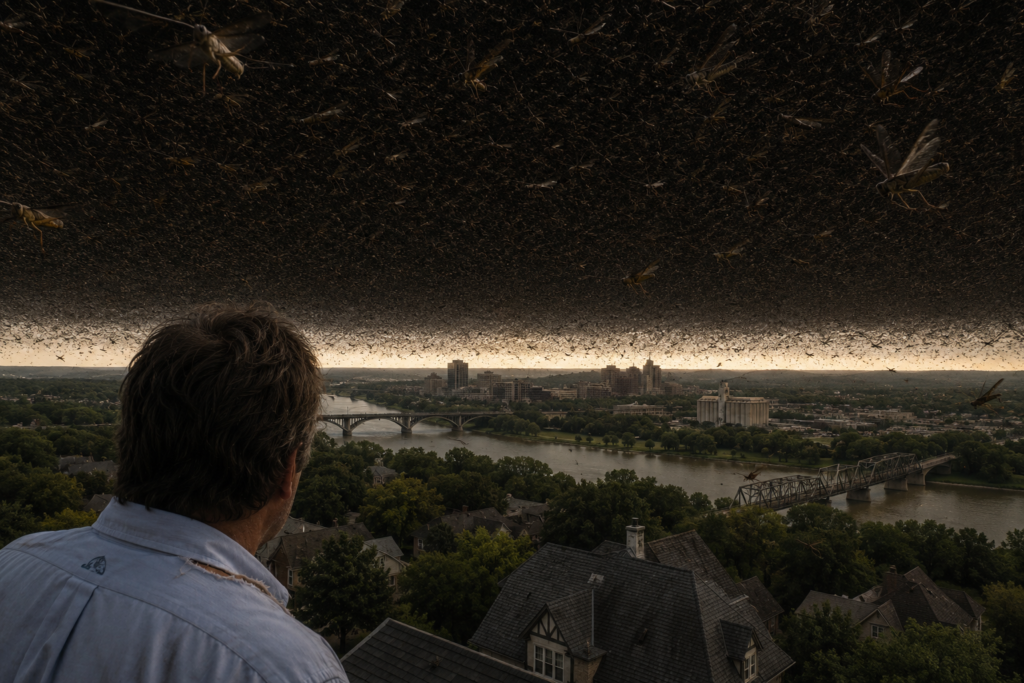
Set in a ruined Saskatoon, the novel follows the disintegration and survival of one family as a continent-scale swarm of mutated semi-metallic locusts descends upon the city.
The concept brilliantly weaponizes prairie geography.
On flat land, there is nowhere to hide from a threat stretching from horizon to horizon.
The open prairie—normally associated with freedom and possibility—becomes a tactical nightmare.
The numbers used to live on screens. Now, they have teeth.
Inside a deteriorating house in a ruined Saskatoon, the walls are closing in long before the horizon changes.
Troy, a broken former finance executive, spends his days obsessively calculating water rations and clinging to the ghost of his lost status.
His wife, Jenny, once a highly curated trophy partner, has been forced into a fierce, unblinking pragmatism, managing the house with a cold clarity while trying not to drown in the bitter, silent warfare of their dying marriage.
Down the hall, their teenage son, Liam, frantically logs empty radio frequencies to drown out their arguments, while eleven-year-old Clara retreats to the garden, feeding worms to a heavy, lead-veined insect she treats like a pet and calls Pewter.
Then, on a Tuesday morning at exactly 11:14 AM, the howling prairie gales cut out entirely.
In the suffocating stillness, a kilometres-wide wall of absolute darkness surges over the northern bluffs. It is a compounding, multi-million-bodied horde of mutated, semi-metallic locusts, insects with lead veining the chitin, making them nearly indestructible, and driven by a single, rolling collective mind that shaves the landscape to the bone.
As the windows shatter inward and the heavy carapaces begin to chew through the drywall, the family’s domestic fronts completely shatter.
To survive the night, they must get through a visceral, zero-sum war of pure survival.
At its core, The Front explores:
- family collapse,
- class identity,
- survival,
- domestic conflict,
- adaptation.
The apocalypse arrives not only outside the house, but within it.
The Future of Saskatchewan Apocalypse Fiction
Saskatchewan remains one of the least explored settings in speculative literature.
That may soon change.
Modern readers increasingly seek stories rooted in authentic places rather than generic post-apocalyptic landscapes.
Saskatchewan offers authenticity in abundance. Its history, geography, climate, and agricultural identity naturally generate compelling speculative narratives.
Most importantly, the province possesses something essential to great post-apocalyptic fiction:
scale.
The sky is enormous. The distances are enormous. The silence is enormous.
And when something appears on the horizon, everyone can see it coming.
The real terror lies in knowing that sometimes seeing it is not enough.
© Copyright 2026 WARRIORS OF THE LAST DAYS All rights reserved Privacy Policy
- Post-Apocalypse Stories in Saskatchewan:Why the Canadian Prairies Are Perfect for the End of the World
- Why Saskatchewan Works So Well as a Post-Apocalyptic Setting
- Existing Post-Apocalyptic and Dystopian Fiction Connected to Saskatchewan
- Other Canadian Dystopian Works Worth Exploring
- Saskatchewan’s Untapped Apocalyptic Potential
- Saskatchewan Horror Beyond Zombies
- Saskatchewan’s Emerging Post-Apocalyptic Voices
- THE FRONT NOVEL SYNOPSIS
- The Future of Saskatchewan Apocalypse Fiction
 Stéphane Roy is a lifelong reader and writer with a deep love for science fiction, apocalyptic worlds, and tightly constructed mysteries. This is his first novel. He lives in the Yukon with his dog and his aquarium, where long winters, silence, and wide, sometimes glowing, skies leave plenty of room for imagining the end of the world, and what might come after it. He is also waiting, with cautious optimism, for the aliens to finally reveal themselves and straighten us all out.